
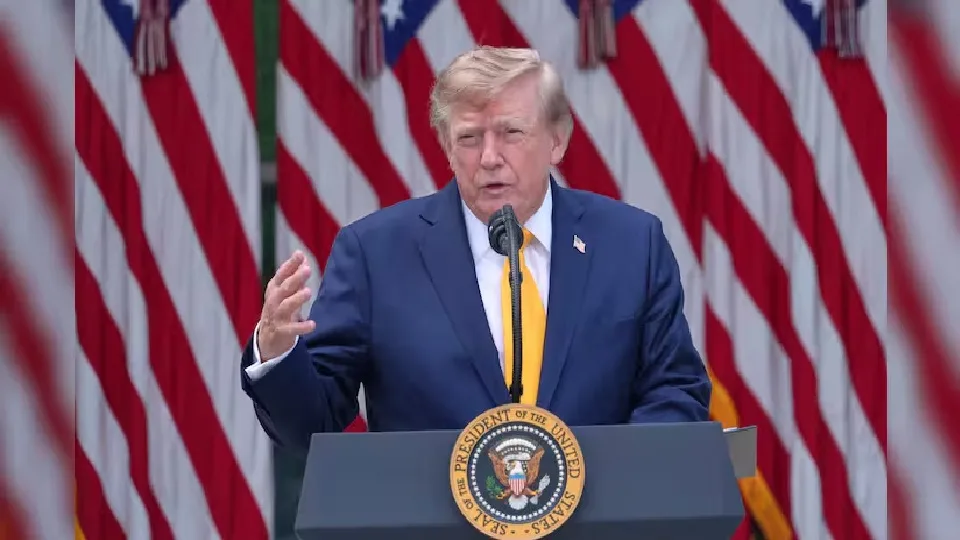
US President Donald Trump has once again turned election politics into a spectacle, this time by confusing India with Brazil while trying to make a broader argument about the speed and credibility of the American electoral system.
In a Truth Social post, Trump claimed that 125 million people had voted in the first round of India’s “Presidential Election” and praised the speed with which the results were announced. But the election he appeared to be referring to was Brazil’s presidential vote, held on October 4.
The mistake was not merely geographical.
India did not hold a presidential election. Its president is elected indirectly by an Electoral College made up of elected members of Parliament and state legislatures. The country’s next presidential election is not due in 2026.
Brazil, by contrast, held the first round of its presidential election on Sunday, with roughly 125 million votes cast. The contest between incumbent Luiz Inácio Lula da Silva and Senator Flávio Bolsonaro is heading to a runoff after neither candidate secured more than half of the valid votes.
The distinction matters because Trump was using the Brazilian election as a comparison with the United States while attributing it to India.
His larger argument was aimed squarely at American elections. Trump contrasted the rapid announcement of Brazil’s results with what he described as lengthy counting periods in places such as Detroit, Philadelphia and California. He then alleged that US voting was “CORRUPT,” without presenting evidence for the claim.
The irony was difficult to miss.
A post intended to criticise the accuracy and efficiency of another country’s electoral system began with an incorrect description of the country whose election Trump was discussing.
The episode also illustrates how easily complex electoral systems can be reduced to misleading comparisons.
Brazil uses electronic voting and is known for rapidly reporting results. India, meanwhile, operates one of the world's largest electoral systems, but its presidential election is fundamentally different from a direct popular vote. Indian voters directly elect representatives to the Lok Sabha and state legislatures, while the president is chosen through an electoral college.
There was therefore no Indian presidential vote from which a figure of 125 million voters could have been drawn.
The number itself appears to have come from Brazil. More than 124 million Brazilians participated in the first round, making Trump's figure broadly consistent with the scale of the Brazilian election.
The confusion comes at a politically sensitive moment in Brazil.
The first-round result produced a closely contested race between Lula and Flávio Bolsonaro, the son of former President Jair Bolsonaro. Flávio emerged with about 47 per cent of the vote, while Lula received roughly 45 per cent, sending both into a runoff scheduled for October 25.
The Brazilian election also carries significance for Washington. Flávio Bolsonaro is closely associated with his father's political movement and has positioned himself as a conservative ally of Trump. Lula, meanwhile, has had increasingly difficult relations with the Trump administration.
That makes Trump's interest in the Brazilian election understandable.
But the India reference adds an entirely different dimension to the episode.
It is not the first time Trump has invoked India while discussing American electoral policy. He has previously cited India's voter-identification practices and the scale of its elections while arguing for changes to US voting rules.
That makes the latest mix-up more than an isolated slip. It reinforces the risks that arise when political arguments are built around comparisons with foreign electoral systems without getting the basic facts right.
There is also a broader lesson.
Election systems are shaped by different constitutional structures, populations, technologies and legal frameworks. Comparing the speed of vote counting across countries can be useful, but only if the underlying systems are actually comparable.
India's presidential election is not Brazil's presidential election. Brazil's electronic voting system is not the US system. And the speed at which results are reported does not, by itself, establish whether an election is more or less legitimate.
Trump's post attempted to turn a foreign election into evidence for a domestic political argument.
Instead, the most striking part of the message became the factual error at its centre.
A president arguing that elections must be trusted may have inadvertently demonstrated the opposite lesson: before judging how another democracy counts its votes, it helps to know which democracy actually held the election.