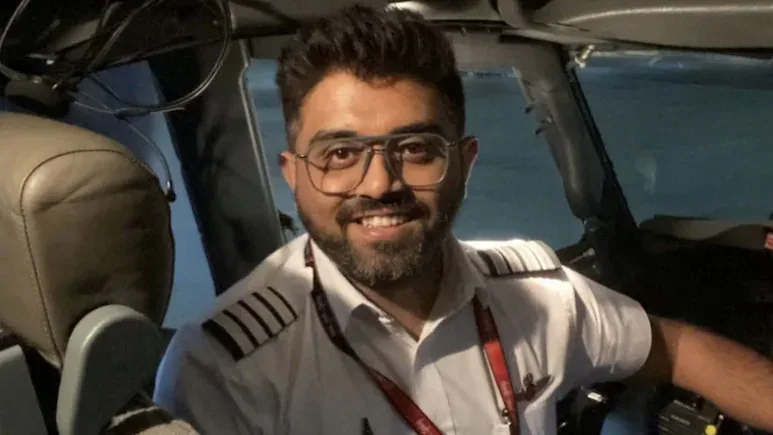
Captain Smit Machchhar was already badly injured when he realised that the aircraft he was flying was rapidly descending. Bleeding and struggling to see, the Indian pilot understood that opening the cockpit door could be the difference between survival and catastrophe.
Machchhar has now described those moments in a conversation with Israeli Prime Minister Benjamin Netanyahu, offering a firsthand account of the attack aboard a flydubai flight travelling from Dubai to Tel Aviv.
The flight had begun normally. Machchhar said his co-pilot, Omani national Hamam al-Hammami, had asked to pray. Machchhar said he turned his attention toward the front of the cockpit, considering the request unremarkable.
Several minutes later, he felt a heavy blow to the back of his head.
His initial reaction was that something catastrophic had happened to the aircraft. But the blows continued, one after another. It was then, he said, that he understood the danger was coming from the other person inside the cockpit.
Machchhar tried to resist, but the attack had left him seriously disoriented. His vision was severely impaired and he struggled to defend himself.
The situation became even more critical when the aircraft began a steep descent.
At one point, Machchhar attempted to open the cockpit door, but said the co-pilot closed it again. The captain eventually found himself on the floor of the cockpit, injured and barely able to see.
Then came the realisation that he had one final opportunity to act.
“I had that one last fight left in me,” Machchhar told Netanyahu.
He pushed himself up and forced the cockpit door open.
Passengers and crew members were waiting outside and immediately moved in to restrain the attacker. Two off-duty pilots who were travelling on the aircraft also helped take control of the situation and eventually flew the aircraft to safety.
The Boeing 737 had suffered a dramatic loss of altitude during the confrontation. Flight-tracking data indicated that it dropped by more than 14,000 feet in less than 30 seconds.
The aircraft was diverted to Tabuk in northwestern Saudi Arabia, where it made an emergency landing. Everyone aboard survived.
Machchhar’s account adds a personal dimension to an incident that initially appeared as a sudden aviation emergency. His actions came while he was being repeatedly attacked and seriously wounded, yet he remained aware that the aircraft was carrying hundreds of other people.
The captain later told Indian Prime Minister Narendra Modi that he had been flying for 17 years and had served as a captain for 11 years. That experience, he said, allowed him to understand what was happening to the aircraft even after he had fallen to the cockpit floor.
He has also credited faith with helping him through the ordeal.
Machchhar is recovering from his injuries in the United Arab Emirates. His account has drawn international attention, with Modi and Netanyahu among the leaders who have publicly praised his actions.
Netanyahu told Machchhar that he was impressed by his courage and judgment under extraordinary circumstances.
The circumstances surrounding the co-pilot’s actions remain under investigation. Authorities in Saudi Arabia, the United Arab Emirates and Israel are examining the incident, including the attacker’s motive and whether anyone else was involved.
The investigation has already raised questions about aviation security and the vetting of flight crew, but several key aspects remain unresolved.
For Machchhar, however, the decisive moment came before any of those questions could be answered. Wounded and disoriented, he recognised that the aircraft was descending and that the cockpit door had to be opened.
His final push allowed others to enter, restrain the attacker and help restore control of the aircraft.
What began as a routine flight from Dubai to Tel Aviv had become a fight inside a locked cockpit. Machchhar’s account makes clear how narrow the margin was between that confrontation and a far greater disaster.
Lead with the cockpit attackTighten the repeated endingClarify the rescue sequence