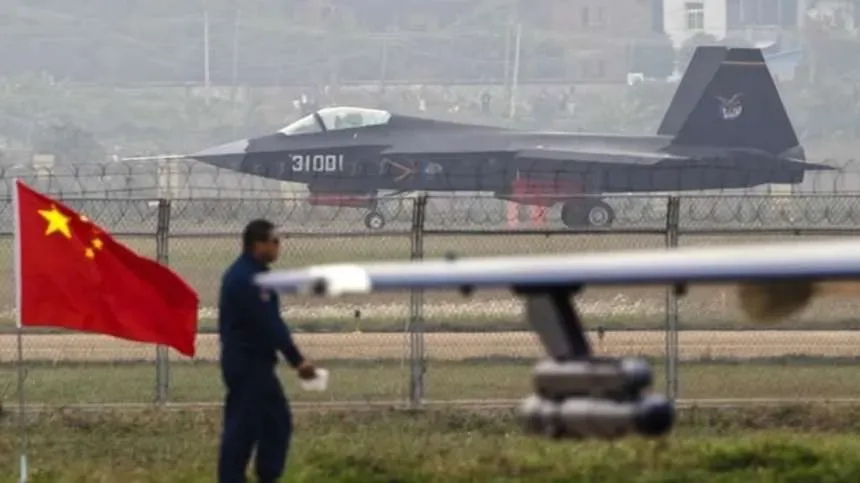
BEIJING — China has opened a joint military support and training facility in Laos, establishing its first acknowledged overseas facility centred on air power and expanding the People’s Liberation Army’s presence in Southeast Asia.
The China-Laos Joint Support and Training Centre and the China-Laos Friendship Aviation Academy began operations at Ban Keun Airport, about 50 kilometres north of Vientiane. China’s Defence Ministry said the facilities would be jointly operated and maintained and would primarily support the training of Lao air force pilots.
Beijing said the centre was established through consultation between the two governments and was not directed against any third country. It did not disclose how many Chinese personnel or what military equipment would be stationed at the site.
The facility nevertheless represents an expansion of China’s limited network of overseas military facilities. Beijing opened its first overseas military base in Djibouti in 2017 and has since developed a joint naval training and support facility at Cambodia’s Ream Naval Base.
The Laos facility differs from those installations because of its focus on air operations. Analysts say the arrangement could give the Chinese military more persistent access to a strategically located facility, although its eventual role remains uncertain.
Commercial satellite imagery shows that construction at Ban Keun expanded substantially over the past year. A paved runway, parallel taxiway, aircraft apron and several new buildings have replaced what had previously been a much smaller airstrip surrounded by agricultural land.
Construction began in late 2025, according to satellite imagery. The main runway is about 2,000 metres long.
The site has historical military significance. Ban Keun was part of the network of airfields used by the United States during the Vietnam War and the conflict in Laos. The current development, however, is considerably larger than the earlier airstrip.
Chinese and Lao officials have presented the project as a military training partnership. Laos has a small air force operating a limited number of Chinese- and Russian-designed aircraft, and its personnel have traditionally travelled abroad for advanced training.
The new facility will allow at least some of that training to take place inside Laos with Chinese assistance.
The broader strategic implications will depend on how the facility develops. Analysts say indicators such as the duration of Chinese aircraft deployments, the number of personnel stationed there and whether China receives exclusive access to parts of the complex would help determine whether the centre remains primarily a training facility or develops into a more substantial military outpost.
Rachel Vandenbrink, a senior analyst at the Australian Strategic Policy Institute, said the joint support and training arrangement could provide the PLA with persistent access to a logistics hub supporting forces rotating through Laos.
Other analysts have cautioned against treating the new facility as equivalent to China's established overseas base in Djibouti. The current infrastructure may support training aircraft and light military operations, while the extent of any permanent Chinese presence remains unknown.
China's military relationship with Laos has strengthened in recent years. The two countries have conducted joint exercises, including humanitarian-response training, while Lao President Thongloun Sisoulith has maintained close engagement with Chinese President Xi Jinping.
The new facility also follows the model used at Cambodia’s Ream Naval Base, where China helped develop a joint training and logistics centre. That facility has strengthened Beijing’s military access to the Gulf of Thailand, although Cambodia has denied that Chinese forces are permanently stationed there.
The two facilities form part of a broader pattern in China's overseas defence activities. Beijing has sought to develop military access and partnerships without publicly describing all of them as permanent Chinese bases.
The United States and regional governments are watching the expansion closely. Washington maintains a much larger network of overseas military installations, while China has argued that its facilities are intended to support legitimate defence cooperation and overseas operations.
Thailand, which shares a long border with Laos and maintains security relationships with both Washington and Beijing, has said Laos has the sovereign right to decide whether to host Chinese military facilities. Thai officials have nevertheless indicated that developments at Ban Keun will be monitored closely.
Vietnam is also likely to be attentive to the development given its strategic relationship with Laos and its longstanding concerns about China's growing military presence in mainland Southeast Asia.
For Laos, the arrangement provides access to Chinese military training, equipment and expertise while deepening defence ties with its largest economic partner. For Beijing, it provides another platform for military cooperation in a region where its strategic influence has expanded rapidly.
The immediate military value of the Ban Keun facility remains unclear. Its significance will depend largely on whether China's role remains limited to training Lao personnel or develops into a sustained presence involving Chinese aircraft, personnel and logistics.
For now, the opening gives China an additional military foothold outside its borders and extends its overseas defence network into mainland Southeast Asia.