
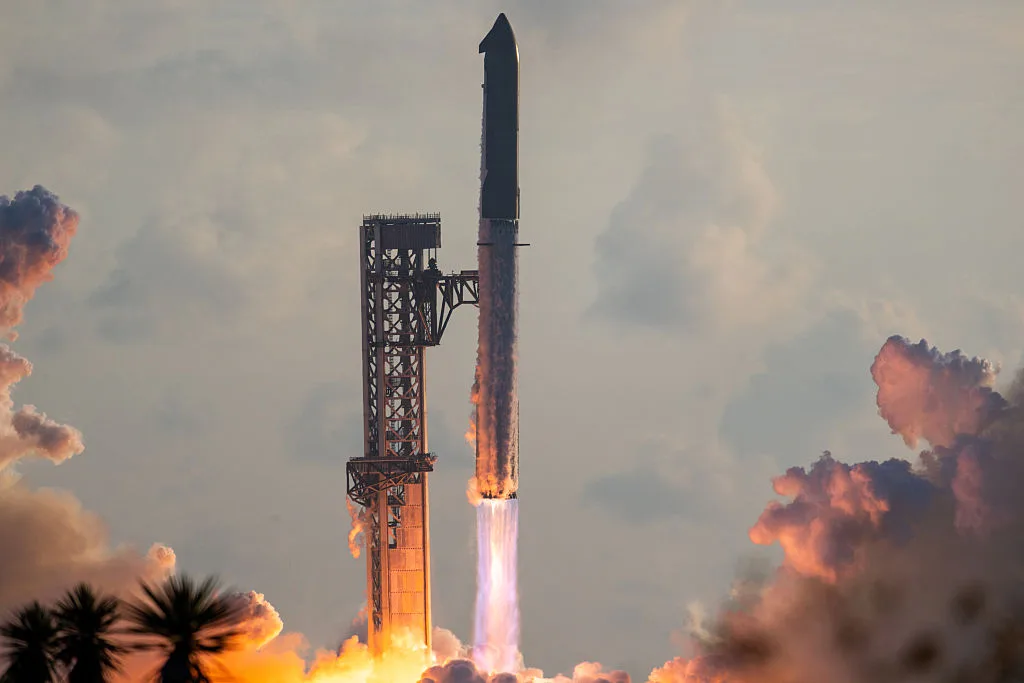
STARBASE, Texas — SpaceX’s Starship reached orbit for the first time on Monday and deployed 26 next-generation Starlink satellites, completing the rocket’s most ambitious test flight to date despite an engine failure that forced the mission to end several hours earlier than planned.
The uncrewed Starship lifted off from SpaceX’s Starbase facility in South Texas on its 14th flight. The mission was designed to last about 10 hours and test the spacecraft across several stages of an orbital mission, but SpaceX shortened the flight after one of Starship’s engines shut down prematurely.
The engine problem initially raised doubts about whether the spacecraft could reach orbit. SpaceX engineers nevertheless determined that the vehicle retained enough capability to perform the critical orbital insertion burn.
Starship subsequently reached a stable low-Earth orbit and deployed 26 Starlink V3 satellites at an altitude of about 269 kilometres. It was the first time Starship had delivered an operational payload to orbit, turning what had previously been a test-only programme into a flight carrying commercial hardware.
The V3 satellites are designed to provide substantially greater capacity than the older Starlink satellites launched aboard SpaceX’s Falcon 9 rockets. SpaceX says each V3 satellite can handle about 10 times more data than its predecessor, allowing the company to expand network capacity as the new spacecraft enter service.
All 26 satellites were deployed and established contact with SpaceX, according to the company.
The mission began with the Super Heavy booster lifting Starship into space before separating from the upper stage. The booster performed a controlled return manoeuvre and splashed down in the Gulf of Mexico.
The upper-stage Starship continued towards orbit, but one of its three main engines shut down earlier than expected. The remaining engines compensated for the problem long enough for engineers to assess whether the spacecraft could safely attempt the orbital insertion burn.
SpaceX initially indicated that it might abandon the attempt to reach orbit. Engineers later determined that the spacecraft could proceed, and Starship successfully reignited an engine to complete the insertion manoeuvre.
The decision reflected the risk involved in placing a large spacecraft into orbit. Once in orbit, Starship would have needed a functioning engine and other systems to perform a controlled de-orbit manoeuvre. SpaceX therefore limited the mission after the earlier engine problem rather than proceeding with the full planned duration.
After deploying the Starlink satellites, Starship conducted its de-orbit burn and began its return to Earth.
The spacecraft re-entered the atmosphere and completed a controlled descent towards the Pacific Ocean north of Hawaii. It executed its final landing manoeuvre before splashing down roughly three hours after launch.
The vehicle was not designed to be recovered from the ocean on this flight. It tipped over and broke apart in a fireball after reaching the water.
The successful orbital insertion nevertheless represents an important technical step for SpaceX’s Starship programme. All 13 previous Starship test flights since 2023 had remained on suborbital trajectories, meaning the spacecraft did not complete a full orbit around Earth.
Starship has been developed as a fully reusable launch system capable of carrying substantially larger payloads than SpaceX’s existing Falcon 9 rocket. Its eventual role is expected to include frequent Starlink launches as well as missions for NASA’s Artemis programme.
The spacecraft is also central to SpaceX’s plans for expanding the Starlink network. The larger V3 satellites are too big for Falcon 9 and are intended to be launched aboard Starship in much larger batches once the system becomes operational.
SpaceX has said future Starship missions could deploy as many as 60 V3 satellites at a time. That capacity would allow the company to increase Starlink's network capacity more rapidly than is possible with its current launch system.
The mission also provided a test of systems that will be required for future human and deep-space missions. NASA plans to use a version of Starship as part of its Artemis programme to transport astronauts to the lunar surface.
Those missions will require far greater reliability than was demonstrated on Monday. Starship must ultimately perform repeated launches, orbital operations, controlled re-entry and recovery while supporting much longer missions.
For SpaceX, Monday's flight therefore delivered both a successful orbital demonstration and a reminder of the engineering challenges that remain. The spacecraft reached orbit and delivered its payload, but the early engine shutdown prevented engineers from completing the full mission profile.
The company is expected to use data from the flight to address the engine issue and prepare Starship for subsequent missions as it works towards regular orbital operations.