China’s expanding presence in the Bahamas highlights a broader shift in global power competition: strategic influence is increasingly built through commercial infrastructure, political relationships, technology and long-term access rather than through military bases alone.
The Caribbean archipelago lies just 80 kilometres from the United States at its nearest point. Its location also places it along maritime routes relevant to American military movements. Beijing’s growing network of business interests and institutional relationships therefore carries implications beyond the Bahamas’ domestic economy.
The concern is not that every Chinese investment represents a security threat. It is that a collection of individually commercial projects can, over time, create a wider structure of economic dependence, political access and potential strategic utility.
That distinction matters. China’s advance in the Bahamas should be assessed neither through automatic suspicion of Chinese capital nor through the assumption that commercial engagement is geopolitically neutral. The central question is whether the country has sufficient safeguards to protect its sovereignty, infrastructure and decision-making as foreign investment expands.
Commercial Infrastructure With Strategic Consequences
Chinese-linked businesses have established a presence across several important sectors of the Bahamian economy, including port operations, tourism, construction, telecommunications, surveillance technology and energy.
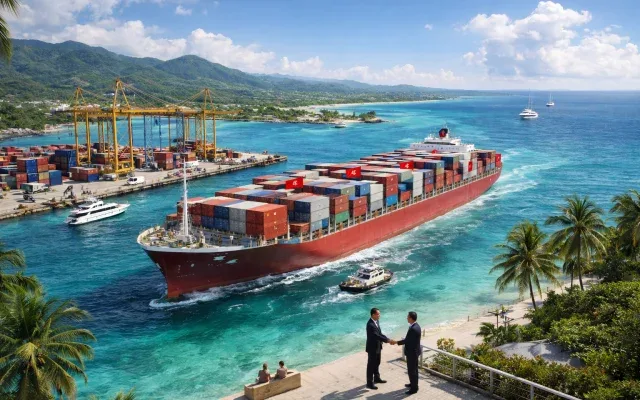
Hutchison, the Hong Kong-based company, operates the principal port and container terminal at Freeport, as well as its cruise ship terminal. The company is undertaking a reported $100 million modernisation programme involving cranes and other equipment. Separately, the $4.2 billion Baha Mar resort is owned by Macau-based Chow Tai Fook Enterprises, while China Construction America has been involved in several major construction and hospitality projects.
These investments can deliver tangible economic benefits. Ports facilitate trade, resorts support tourism, construction generates activity, and telecommunications and energy projects can help modernise essential services. For a small island economy, external capital and technical expertise can be important sources of development.
Yet the strategic significance of infrastructure does not depend exclusively on who formally owns it. It also depends on who operates it, who maintains its technology, who controls access to information and how easily the host government can intervene when national interests are at stake.
Ports are particularly sensitive because they connect commercial logistics with maritime access. Telecommunications networks carry government, business and personal data. Surveillance systems collect information about people and activity. Energy infrastructure supports nearly every other economic sector.
None of these functions automatically turns a commercial asset into a military instrument. But foreign control, opaque contractual arrangements, weak oversight or limited alternatives can create vulnerabilities that become more consequential during a diplomatic crisis.
This is why the Bahamas’ growing Chinese commercial footprint deserves a sector-by-sector assessment rather than a blanket judgment about Chinese investment.
The Problem of Dual-Use Infrastructure
The distinction between commercial and strategic infrastructure is becoming increasingly important in an era of technological competition.
Equipment installed for legitimate civilian purposes may generate data, provide access to facilities or create dependencies that matter in a security emergency. The risk can be particularly acute when infrastructure is difficult to replace quickly or when a foreign supplier retains a substantial role in its maintenance and operation.
The presence of Chinese telecommunications equipment, including Huawei products, and surveillance technology supplied by Hikvision raises questions about cybersecurity, data protection and the independence of critical systems. Such concerns should be examined through technical audits, procurement transparency and enforceable security standards—not merely through the nationality of a supplier.
The same principle applies to port operations. A modern terminal is primarily an economic asset, but its location and logistical functions may acquire wider significance during a regional conflict. The Bahamas’ proximity to the United States and its position along maritime routes make the resilience and governance of its ports relevant to American security planning.
However, strategic potential must not be confused with evidence of hostile activity. Commercial access does not, by itself, demonstrate that Beijing intends to use a facility for military operations or intelligence collection. Such conclusions require specific evidence.
The more defensible argument is that governments should anticipate foreseeable risks before a crisis makes them harder to manage. The Bahamas can preserve the economic benefits of foreign investment while requiring clear ownership disclosures, independent security assessments, robust data protections and the ability to maintain critical services if a supplier relationship deteriorates.
Influence Extends Beyond Business
China’s presence in the Bahamas is not confined to commercial projects. Beijing has also cultivated relationships with political representatives, security personnel, business figures, journalists, academics and students.
These connections include training programmes for Bahamian security personnel, exchanges involving political parties, visits by professional groups and educational initiatives linked to Chinese language and culture. Chinese institutions have also organised activities involving Bahamian media representatives.
Such engagement is a familiar feature of international diplomacy. Governments regularly use scholarships, training, cultural exchanges and professional visits to build relationships and improve their international standing. China is not unique in doing so, and participation in these programmes does not establish that an individual has become an instrument of a foreign government.
The issue is transparency and reciprocity. When exchanges are financed by a foreign state, audiences should be able to understand who funded them, what commitments were attached and whether participants are expected to disclose those relationships when commenting publicly on the sponsoring country.
This is particularly important in a small political and media environment, where a relatively limited number of institutions and influential individuals can shape public debate. A sustained programme of engagement may help a foreign government build familiarity, access and goodwill. Over time, those relationships can influence how its policies and international role are understood.
That possibility is not proof of covert interference. It is a reason to establish transparent rules that apply consistently to all foreign governments.
The Bahamas should protect the independence of its political institutions, media and universities without treating ordinary educational or cultural exchange as inherently suspicious. Openness and scrutiny are compatible; indeed, transparency helps preserve public confidence in international engagement.
Washington Cannot Rely on Geography Alone
The Bahamas’ proximity to the United States gives Washington an obvious strategic interest in developments across the archipelago. But geography does not guarantee political alignment, nor does it give the United States an automatic right to determine the country’s commercial partnerships.
Bahamian governments must answer first to Bahamian citizens. Their priorities include employment, tourism, infrastructure, public services and economic resilience. If Chinese companies offer financing, construction capacity or technology that other partners are unwilling or unable to provide, Nassau has practical reasons to consider those opportunities.
A US response built mainly around warnings about Beijing is unlikely to address those underlying incentives. If Washington wants regional governments to reduce particular dependencies, it must offer credible alternatives: competitive investment, reliable infrastructure financing, technical assistance and partnerships that respect local priorities.
That means engagement beyond security declarations. The United States can help strengthen cybersecurity, improve port resilience, support transparent procurement and expand cooperation in renewable energy and digital infrastructure. It can also work with regional institutions to develop standards that protect small states from opaque contracts and excessive concentration in essential sectors.
Such an approach would address vulnerabilities without demanding that the Bahamas choose sides in every aspect of the wider US-China rivalry.
Washington also needs to distinguish between economic competition and national security. Not every Chinese-owned hotel or construction project carries the same implications as a telecommunications network or a strategically located port. Policy should reflect those differences.
Overly broad restrictions could impose economic costs on the Bahamas, undermine legitimate development and encourage the perception that US concern is motivated by a desire to preserve exclusive influence rather than to protect clearly defined security interests.
Sovereignty Requires Strong Institutions
For Nassau, the most important response is not to replace one external partner with another. It is to ensure that no outside power can gain disproportionate leverage over essential national systems.
That begins with transparent contracts and clear rules on foreign ownership. Major infrastructure agreements should identify the ultimate owners of participating companies, specify obligations to employ and train local workers, and establish enforceable standards for labour practices and regulatory compliance.
The record of Chinese-linked construction and hospitality projects has included disputes over contractual obligations and the employment of foreign workers. Such matters are not merely geopolitical concerns. They directly affect local employment, public confidence and the government’s ability to enforce its own laws.
Telecommunications, surveillance and energy projects require additional safeguards. Independent technical reviews, secure data-handling rules, diversified suppliers and credible contingency plans can reduce the risks associated with reliance on a single company or country.
Security cooperation should also be transparent. Training programmes and equipment donations may offer practical benefits, but the government should disclose their terms and assess whether they create long-term maintenance dependencies or limit operational independence.
These measures should apply equally to Chinese, American and other foreign investors. A consistent framework is more credible—and more protective of sovereignty—than ad hoc restrictions imposed according to diplomatic pressure.
The objective is not economic isolation. It is to ensure that international partnerships remain reversible, accountable and compatible with the national interest.
The Wider Caribbean Lesson
The Bahamas illustrates a challenge facing many small states in an increasingly competitive international system. They need investment and external partnerships, yet the same relationships can create dependencies that become difficult to manage when strategic tensions rise.
China has demonstrated that sustained commercial engagement can build a presence across ports, technology, tourism, energy and public institutions. The strategic implications emerge not necessarily from any single project but from the interaction among them.
For the United States, the lesson is that regional influence cannot be maintained by proximity alone. It requires consistent economic engagement and respect for the priorities of neighbouring countries. For China, commercial expansion may generate influence, but that influence can also provoke scrutiny when local institutions appear unable to enforce their own rules.
For the Bahamas, the task is more immediate: secure the benefits of foreign investment while ensuring that economic opportunity does not weaken regulatory independence or compromise critical infrastructure.
The country does not need to treat every Chinese project as a security threat. Nor should it assume that commercial relationships are detached from geopolitical competition. Both approaches would oversimplify the choices before it.
The decisive test is whether Bahamian institutions retain the authority, expertise and practical capacity to govern the infrastructure and relationships on which the country increasingly depends. If they do, foreign investment can remain a tool of development. If they do not, economic partnerships may gradually become sources of strategic leverage.
China’s advance in the Bahamas is therefore not simply a story about Beijing moving closer to American shores. It is a test of how a small state can preserve its autonomy in a world where the boundaries between commerce, diplomacy and security are becoming harder to separate.