Pakistan's claims of having secured its western frontier are increasingly difficult to reconcile with its own military briefings. Islamabad boasts of fencing nearly the entire Afghan border, yet continues to report terrorist infiltration. Meanwhile, allegations of drone-assisted smuggling across the eastern frontier raise questions that official explanations have conspicuously avoided.
There is something remarkable about Pakistan's western border. Depending on which official is speaking, it is either almost completely sealed, exceptionally difficult to control, or persistently vulnerable to infiltration. All three positions appear to coexist comfortably within the country's official security narrative.
The numbers, at least, are impressive. In January 2021, the Pakistan Army claimed that more than 83 per cent of the border with Afghanistan had been fenced. By August that year, the figure had risen to 90 per cent. Subsequent statements put it at 94 per cent, before a Frontier Corps official cited 98 per cent completion along the 2,611-kilometre frontier, with 388 of 443 planned forts reportedly constructed in Khyber Pakhtunkhwa.
Such progress should, in theory, have made infiltration increasingly difficult. Yet Pakistan's own security establishment continues to report armed groups crossing from Afghan territory.
In April 2026, Pakistan's Information Ministry dismissed reports of barbed wire being removed along the Afghan border as fabricated and baseless. The official position was that the fence remained intact. However, the same reporting acknowledged that terrorists continued to infiltrate Pakistan despite the extensive fencing.
This raises an uncomfortable question: what exactly has nearly 100 per cent border fencing achieved if infiltration remains a recurring security problem?
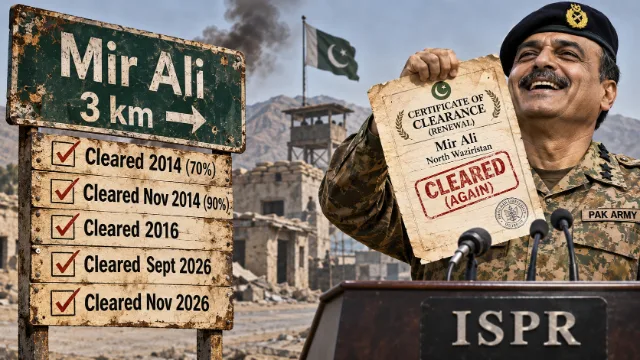
The explanation offered by Pakistan's military establishment is revealing. In a briefing on 25 November 2025, released four days later, the Director General of Inter-Services Public Relations (ISPR) argued that a border fence alone could never guarantee complete security. Effective control, he explained, required observation, fire support and sustained deployment. He also pointed to the 29 tribes living across the border, the distance between security posts and the practical difficulties of monitoring such a long and complicated frontier.
The comparison with the United States-Mexico border was also invoked to illustrate that even heavily secured international boundaries cannot entirely prevent infiltration.
There is a reasonable security argument here. No fence can independently eliminate terrorism, smuggling or illegal crossings. Geography, local communities and the availability of surveillance and manpower all influence border management. Pakistan's security forces also operate in difficult terrain, and the casualties they sustain should not be dismissed.
The same briefing cited 4,910 operations conducted during November and reported the deaths of 57 Army and Frontier Corps personnel. These figures reflect the considerable security burden along the western frontier.
But acknowledging operational difficulties is not the same as answering questions about institutional accountability.
The ISPR chief questioned whether the Army could be held responsible for every terrorist or smuggler who managed to cross the border, particularly when responsibility for the security situation inside Pakistan's territory extended beyond the military's immediate mandate.
It is a fair question. But it cuts both ways.
If the Army claims credit for constructing the fence, establishing security posts and conducting thousands of operations, it cannot entirely distance itself from the effectiveness of the arrangements it presents as evidence of border control. A security establishment cannot simultaneously claim near-total control as an achievement and treat continued infiltration as someone else's responsibility.
Pakistan's official statements this year have repeatedly announced the killing of suspected infiltrators along the Afghan frontier. In April, the ISPR reported that eight infiltrators had been killed in North Waziristan. In September, another announcement put the number at 15. On 12 October, the military reported killing 12 suspected terrorists in Kurram, while one Pakistani soldier was also killed.
The accompanying explanations repeatedly blamed the failure of authorities in Kabul to prevent infiltration. Afghan authorities, in turn, have disputed Pakistan's allegations.
The result is a familiar exchange of accusations, with the border itself becoming a convenient backdrop for competing narratives.
However, the more revealing question concerns Pakistan's other frontier.
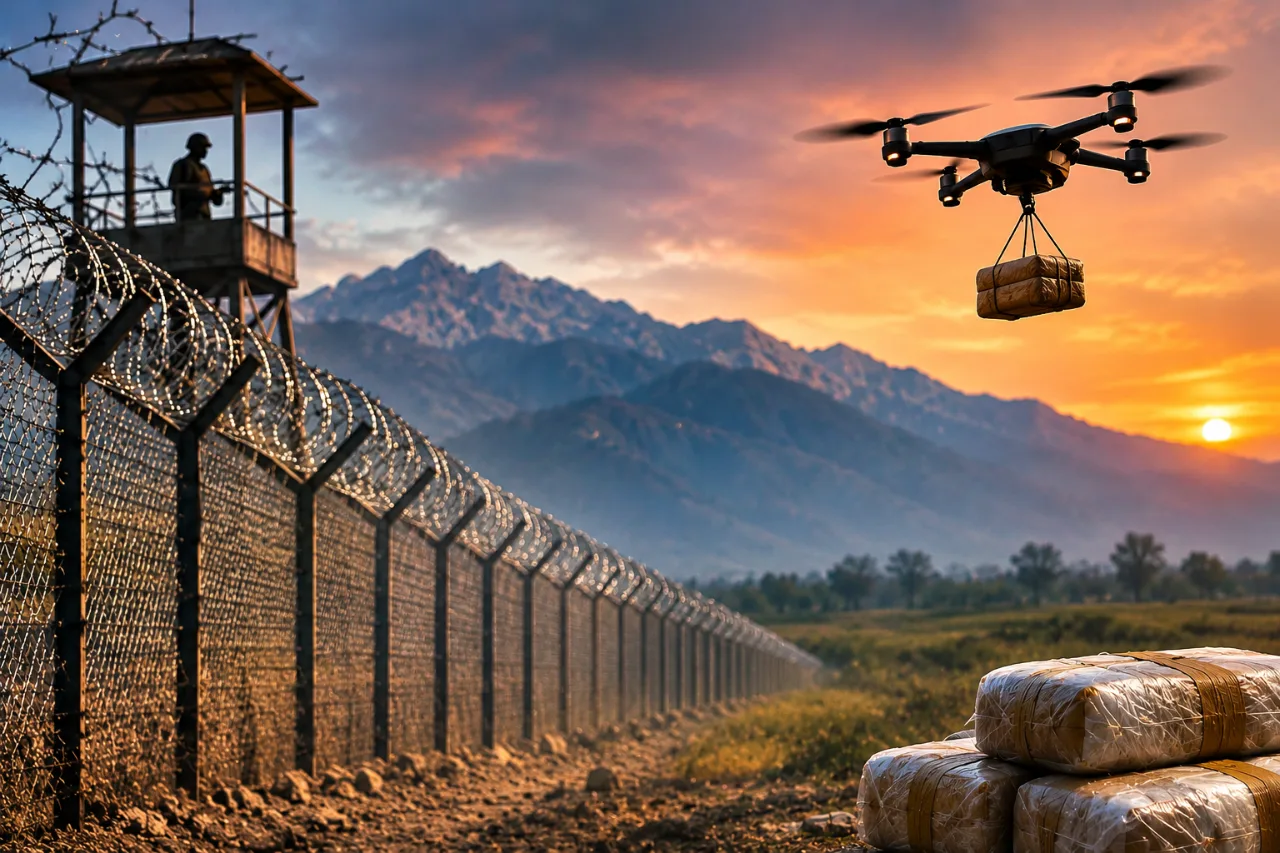
While Islamabad has offered extensive explanations about the difficulties of securing its western border, developments along the eastern frontier have raised a different set of questions. Indian security agencies have reported a growing number of drone recoveries along the Punjab border, many linked to suspected cross-border narcotics smuggling.
According to figures reported by The Tribune in India, the Border Security Force recovered 474 drones and 777 kilograms of heroin along the Punjab frontier between the beginning of 2025 and 27 July 2026. The publication also reported 294 drone recoveries in 2024, compared with 107 in 2023.
These figures, attributed to Indian authorities, point to an increasingly sophisticated method of cross-border smuggling. The recovered machines have reportedly included DJI Mavic models manufactured in Shenzhen, alongside heavier platforms capable of carrying larger payloads.
Unlike conventional infiltration, drone-assisted smuggling does not require individuals to physically cross a fence. It exploits the airspace above it.
That distinction makes the issue particularly important. Pakistan's military spokesperson has spoken at length about the limitations of fencing, the movement of tribal communities and the difficulties of monitoring mountainous terrain along the Afghan border. Yet the growing use of drones along the Punjab frontier presents an entirely different security challenge.
The publicly available material examined for this article does not establish a corresponding detailed Pakistani official response to these reported recoveries. Nor does it establish who, within Pakistan's security establishment, may be responsible for the alleged drone operations.
That distinction matters. Allegations should not be presented as established facts, and the absence of a public response does not independently establish institutional complicity.
Nevertheless, the contrast in public communication is difficult to ignore. Pakistan's military establishment has repeatedly explained why infiltration across its western frontier cannot be completely prevented. It has also offered detailed accounts of security deployments, operational challenges and the alleged failures of Afghan authorities.
The eastern frontier, meanwhile, has received considerably less public explanation in the material available.
For a country that places considerable emphasis on border security, this selective transparency deserves scrutiny.
The issue is not whether Pakistan can make every kilometre of its borders completely impermeable. No country can reasonably guarantee that. The issue is whether its security institutions apply the same standards of accountability when discussing vulnerabilities on different frontiers.
If infiltration across the Afghan border is evidence of Kabul's failure, what should recurring drone recoveries along the Punjab frontier indicate? If Pakistan expects its neighbour to take responsibility for preventing cross-border movement, should it not accept the same expectation regarding its own territory?
These are not unreasonable questions. They are the basic questions of border management and national security.
Ultimately, Pakistan's border-security debate cannot be settled through percentages, press briefings or repeated accusations against neighbouring governments. A fence covering 83, 90, 94 or 98 per cent of a frontier is an infrastructure achievement. It is not, by itself, proof of operational success.
The real measure of border security is whether a state can prevent the threats it identifies, investigate the vulnerabilities it faces and hold the responsible institutions accountable when those systems fail.
Pakistan appears to have developed an elaborate vocabulary for explaining why its western border cannot be completely sealed. What remains less clear is whether it is prepared to apply the same openness to the questions emerging along its eastern frontier.
A border can be fenced, fortified and guarded. But when explanations become more comprehensive than the answers, even the most heavily secured frontier begins to look like a problem of accountability rather than infrastructure.