Protest has always been a means of challenging authority, demanding accountability and bringing neglected grievances into public view. In the digital age, however, dissent has acquired another dimension: it has become a source of attention, engagement and revenue for the platforms that distribute it.
A demonstration once depended largely on the people who attended, the issues they raised and the response they received from those in power. Today, its reach can extend far beyond the streets. A short video, a confrontational speech or a striking photograph can travel across millions of screens within hours. The event itself may last a day, but its digital afterlife can continue for weeks.
This transformation has created new opportunities for civic participation. It has also introduced commercial incentives that deserve closer scrutiny.
The business of public anger
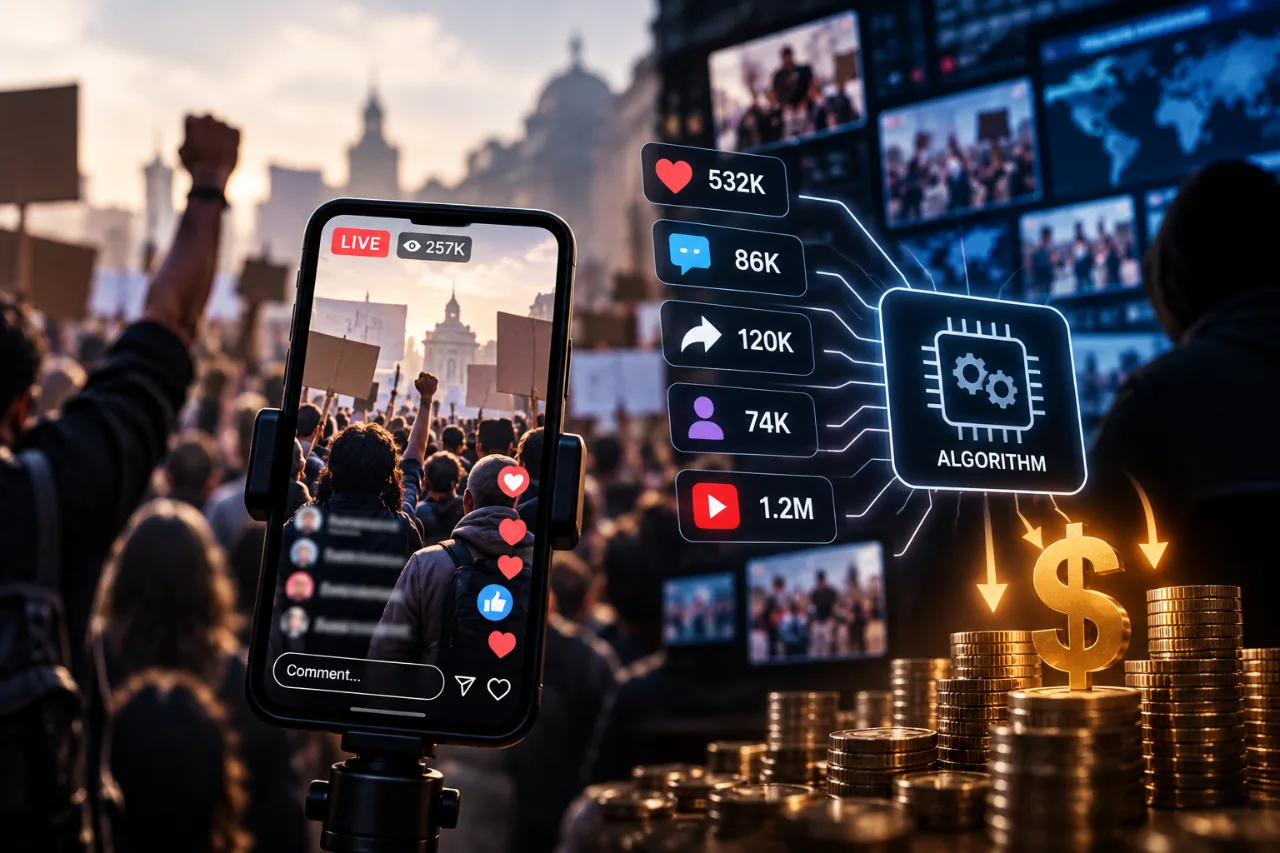
Social media platforms compete for users’ attention. Their recommendation systems help determine which posts appear in feeds, which videos reach wider audiences and which discussions dominate online conversations. Engagement signals can influence distribution, although the precise mechanisms vary across platforms.
Content that provokes strong emotional reactions can attract comments, shares and repeated viewing. Anger, outrage and confrontation are particularly suited to formats that encourage immediate responses. A complicated policy dispute may struggle to compete with a brief clip that presents the same issue as a dramatic confrontation between opposing sides.
The result is a structural tension. Public debate requires context, evidence and patience. Attention-driven digital environments often reward immediacy, emotional intensity and simplicity.
When protest footage becomes popular, creators may gain followers, advertising opportunities or other commercial benefits, depending on the platform and their eligibility. Publishers and influencers can also benefit from the traffic generated by controversial events.
None of this establishes that a protest is manufactured or that its participants are motivated by money. It does, however, raise an important question: when public anger becomes commercially valuable, how do we distinguish the genuine expression of grievance from the incentives surrounding its amplification?
When visibility overtakes substance
Digital platforms have lowered the barriers to participation in public debate. Citizens can document alleged wrongdoing, expose administrative failures and draw attention to issues that receive limited conventional media coverage.
That capacity is valuable, particularly when established institutions fail to respond to legitimate concerns.
Yet visibility is not the same as impact. A hashtag can trend without producing a policy change. A video can attract millions of views without explaining the underlying dispute. A confrontation can dominate the news cycle while the original demand disappears from the conversation.
In this environment, the presentation of a protest can become almost as important as its purpose. The most dramatic moments are clipped, recirculated and detached from their original context. Nuanced arguments give way to easily shared slogans, while participants may find their positions interpreted through the commentary surrounding a viral post.
The danger is not that protest has become digital. It is that the metrics used to measure digital success can become confused with measures of public significance.
A movement's popularity online does not necessarily establish the breadth of public support for its demands. Equally, limited online engagement does not make a grievance less legitimate.
The incentives behind amplification
The protest economy extends beyond those physically present at a demonstration. It includes content creators, digital publishers, advertisers and platform operators, each with different interests.
Creators may seek visibility. Publishers may compete for traffic. Platforms may seek sustained engagement. Political actors may use digital content to mobilise supporters or shape public perceptions.
These interests can overlap without being identical. Nor does the presence of commercial or political incentives, by itself, prove that a protest has been orchestrated.
The more difficult problem arises when the incentives favour sensationalism over verification. An unverified allegation may circulate widely before a correction reaches the same audience. An old video may be presented as a current event. An edited clip may omit the context needed to understand what occurred.
By the time accurate information emerges, the original claim may already have shaped public opinion.
This is why scrutiny must extend beyond the individuals who create misleading content. The systems that recommend, distribute and monetise material also deserve examination. Greater transparency about content distribution, meaningful disclosure of paid political promotion and accessible mechanisms for challenging demonstrably false claims would help strengthen accountability.
Protecting dissent without rewarding manipulation
The response to these problems must not become an argument for treating protest itself as suspicious.
Peaceful dissent is an essential part of democratic life. It allows citizens to challenge decisions, expose failures and demand answers from institutions. Digital platforms have expanded the ability to exercise that right, particularly for groups that might otherwise struggle to attract attention.
The distinction that matters is between protecting the right to protest and scrutinising the practices through which protest-related content is produced and circulated.
Governments must not use the possibility of misinformation as a blanket justification for suppressing criticism. Platforms, meanwhile, should not be absolved of responsibility merely because they present themselves as neutral distributors of user-generated content.
Users also have a role to play. Before sharing a dramatic clip, they can check its date, origin and surrounding context. Before accepting claims about a movement's popularity or funding, they can seek corroboration. Before equating online visibility with public consensus, they can ask what evidence supports that conclusion.
These are modest habits, but they can reduce the ability of misleading content to exploit the speed of digital communication.
The real measure of dissent
The central question is not whether protest should attract attention. Without public visibility, many genuine grievances would remain unheard. Nor is it realistic to expect digital platforms to eliminate controversy from public debate.
The question is whether attention remains a means of advancing public understanding or becomes an end in itself.
A protest should ultimately be assessed by the issues it raises, the evidence supporting its claims, the rights it exercises and the changes it seeks—not simply by the number of views its most dramatic moments generate.
Likewise, the credibility of a movement should not be determined by the commercial success of the accounts covering it. Genuine grievances can coexist with opportunistic content creation, just as misleading material can circulate alongside legitimate criticism.
Democracies need visible dissent. They also need public debate that rewards accuracy, context and accountability. The challenge is to preserve the former without allowing the economics of digital attention to overwhelm the latter.
When algorithms turn outrage into a commodity, the danger is not that every protest becomes a performance. It is that the performance can become more visible than the cause.
And when that happens, the public may end up consuming dissent as content long after it has stopped asking whether the underlying problem has been resolved.