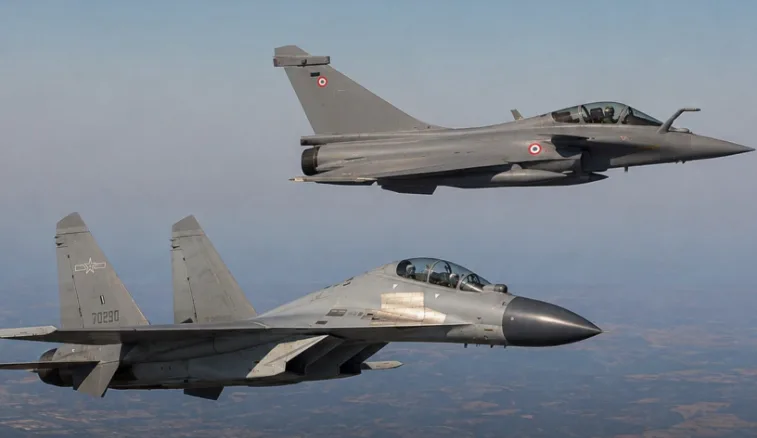
China’s participation in the El Alamein International Airshow 2026 showcased its growing military aviation capabilities. However, questions remain about whether the Shenyang J-16 can match the established operational capabilities and advanced technology of France’s Dassault Rafaele in Egypt from 8–10 September 2026, the event featured four Chinese aircraft making their overseas airshow debuts: the J-16 fighter, Z-20 helicopter, YY-20 aerial-refuelling tanker and KJ-500 airborne early warning aircraft. According to Janes, it represented China’s largest overseas military airshow participation in terms of operational aircraft types. Despite this impressive display, international visibility does not necessarily demonstrate combat superiority.
China’s J-16: Impressive Capabilities But Limited Combat Evidence
The J-16 is a modern multirole fighter equipped with advanced sensors, long-range missiles and precision-strike capabilities. It plays an important role in China’s expanding air force and reflects Beijing’s efforts to strengthen its domestic military aviation industry. However, the aircraft lacks the publicly documented combat experience of France’s Rafale. Although limited combat exposure does not establish technical inferiority, it creates uncertainty about the J-16’s effectiveness and survivability against advanced Western fighters. Military exercises and airshows can demonstrate readiness, but without independently verified engagement data, they cannot conclusively establish battlefield superiority.
2026 Fighter Jet Ranking Places Rafale Above J-16
According to Aero Corner’s published analysis dated 31 July 2026, the Rafale ranked sixth among the world’s leading fighter aircraft, while China’s J-16 occupied eleventh place. The ranking placed the American F-22 Raptor first, followed by the F-35 Lightning II in second and China’s J-20 Mighty Dragon in third. Russia’s Su-57 ranked fourth, while the European Eurofighter Typhoon occupied fifth position. The Rafale ranked ahead of the F-15EX Eagle II, Saab Gripen E, F/A-18 Super Hornet and Su-35. The J-16 appeared five positions below the French fighter. This assessment adds context to the debate surrounding their capabilities. Nevertheless, Aero Corner’s list is an analytical ranking, not an official or universally accepted measure of fighter superiority. Results depend on how factors such as radar, electronic warfare, weapons, manoeuvrability, pilot training and operational support are weighted.
Consequently, the ranking challenges assumptions about Chinese technological dominance but does not prove that the Rafale would win every engagement.
Rafale’s Electronic Warfare and Meteor Missile Advantage
One of the Rafale’s principal strengths is its SPECTRA electronic warfare system, which helps detect and counter threats while improving situational awareness. Combined with the RBE2 AESA radar and passive optical sensors, it provides an integrated approach to threat detection, electronic protection and combat operations. The J-16 also possesses advanced sensors and electronic warfare capabilities. However, their effectiveness is difficult to evaluate independently because detailed operational information remains limited. Another important advantage is the Rafale’s integration with the Meteor beyond-visual-range air-to-air missile. Its ramjet propulsion helps sustain energy during flight, potentially improving effectiveness against manoeuvring targets at long distances.
China’s PL-15 is also a formidable long-range missile, but public information does not establish a definitive performance comparison between the two weapons. Ultimately, detection systems, targeting information, electronic countermeasures and launch conditions can significantly influence engagement outcomes. The J-16’s larger airframe and substantial weapons payload therefore do not automatically guarantee superiority over the Rafale’s integrated combat systems.
Egypt Air Exercises: Unverified Claims of Chinese Victory
The Eagles of Civilization 2026 exercises reportedly brought Chinese J-16 fighters into training encounters with Egyptian Rafales and other aircraft.
Some online media platforms flsely claims the superiority of J16 while other reports suggested that Rafales demonstrated advantages in close-range manoeuvring. Without reliable scoring data, confirmed exercise rules and detailed information from participating air forces, claims about decisive victories remain uncertain.
The controversy illustrates how military exercises can become platforms for competing national narratives rather than transparent demonstrations of combat effectiveness.
Rafale’s Operational Experience Strengthens Its Position
The Rafale has participated in French military operations in Afghanistan, Libya, Mali, Iraq and Syria, undertaking missions involving precision strikes, reconnaissance and air defence. This operational history provides evidence of its use across different environments. By comparison, the J-16 has a limited publicly documented combat record, leaving important questions about its performance against sophisticated opponents unanswered.
However, combat experience alone does not guarantee victory. Pilot proficiency, intelligence, logistics, command networks, mission planning and available weapons all influence the outcome of aerial engagements.
The Rafale’s operational history and higher AeroCorner ranking support its strong international standing, but neither independently establishes how a direct confrontation with the J-16 would unfold.
Publicity Cannot Prove Airpower Superiority
China’s participation in the El Alamein Airshow 2026 demonstrated Beijing’s ambition to expand its international military presence and promote its domestically developed aircraft. Nevertheless, showcasing the J-16 cannot replace independently verified evidence of combat superiority. Aero Corner’s 2026 ranking placed the Rafale sixth and the J-16 eleventh, reinforcing the debate about their relative capabilities. The Rafale benefits from advanced electronic warfare integration, Meteor missile compatibility and extensive operational experience, while the J-16 remains a capable and potentially dangerous fighter whose comparative effectiveness is not fully established publicly.
Ultimately, neither promotional displays nor analytical rankings can definitively determine which aircraft would prevail in combat. The Rafale has demonstrated its capabilities in operational missions across the world, while the J-16’s performance against advanced adversaries remains difficult to assess independently. Credible technical evidence and verified operational results, rather than publicity or unconfirmed victory claims, remain essential to evaluating their true capabilities.