
Xi Jinping’s three-day visit to Washington ended with the ceremonies of a carefully choreographed state occasion: a tour of the National Archives, a twenty-one-gun salute, a military flyover, a state dinner and repeated references to cooperation between Washington and Beijing.
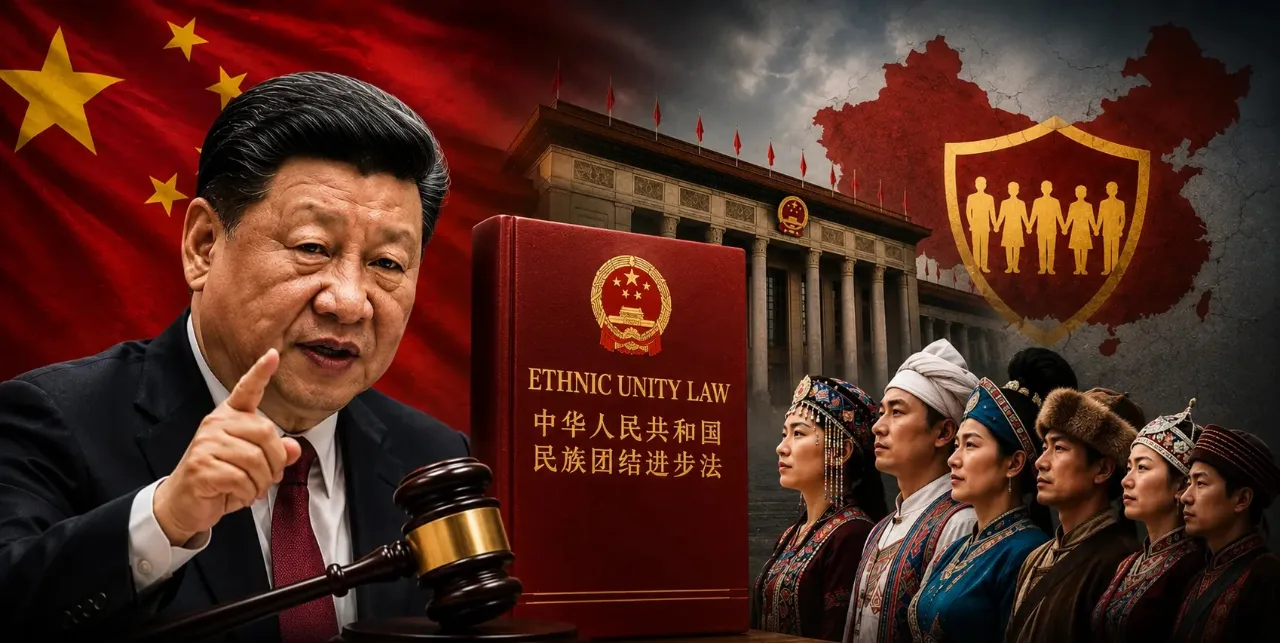
But amid the pageantry, one issue remained conspicuously absent: China’s Law on Promoting Ethnic Unity and Progress.
The omission matters because the law reaches far beyond the ordinary boundaries of domestic legislation. Its provisions establish a Party-defined conception of national unity, impose requirements concerning language and education, address the “Sinicisation” of religion and create penalties for conduct deemed to undermine ethnic unity. Most significantly, Article 63 extends liability to organisations and individuals outside mainland China.
The law was adopted by China’s National People’s Congress on March 12 and entered into force on July 1. Its 65 articles establish what critics describe as a legal framework for reinforcing a single conception of Chinese national identity across the country’s 56 officially recognised ethnic groups.
Article 20 requires parents to raise children to love the Communist Party. Article 31 prohibits information considered harmful to “ethnic unity and progress”, while Article 58 provides penalties for undermining those objectives. Yet the legislation does not clearly define either term.
Article 63 goes further. It extends liability beyond mainland Chinese territory without specifying particular conduct, identifying a jurisdictional procedure or clearly limiting its application to Chinese citizens.
That provision has implications well beyond China's borders.
The concern was raised before the Washington summit. Omer Kanat of the Uyghur Human Rights Project argued that the legislation should be addressed not simply as a human-rights issue but as a question of American sovereignty. Senators Lindsey Graham and Sheldon Whitehouse had also written to Chinese Ambassador Xie Feng warning that any attempt to use Article 63 against people living in the United States would constitute an unacceptable infringement of American sovereignty.
Congressman Jim McGovern similarly called for human rights to be addressed during Xi’s visit.
Yet neither the American nor Chinese readout of the summit mentioned the law. Nor was the broader human-rights issue publicly identified as a central subject of the discussions.
Instead, Washington and Beijing focused on trade, artificial intelligence, Taiwan and international conflicts. The two sides extended their tariff truce by two months and agreed to further meetings.
That silence is important because legislation of this kind does not necessarily depend on conventional enforcement to have an effect.
Its reach can operate through fear and family pressure. A person living in Europe or North America may never face prosecution under Chinese law, but concern over relatives inside China can still influence what that person says, publishes or chooses to investigate.
The pressure can be difficult to document. A relative may face restrictions on travel. A family member may be questioned. Communication may be monitored. The consequence is often not a public prosecution but a private decision to remain silent.
That creates a different kind of challenge for democratic governments.
Transnational repression rarely arrives as a single, easily identifiable criminal act. Instead, it can gradually discourage testimony, activism and public criticism. Scholars may stop publishing under their own names. Witnesses may decline to appear at hearings. Activists may limit their public activity to protect relatives.
Silence therefore becomes part of the mechanism.
The United States is not alone in confronting the issue. Europe has already recognised the potential significance of China's ethnic-unity legislation. On April 30, the European Parliament voted 439 to 52 to condemn the law, called for its repeal, urged member states to suspend extradition treaties with China and asked the European Council to consider sanctions under the EU Global Human Rights Sanctions Regime.
But a parliamentary resolution is not the same as enforcement.
The challenge for Europe is to translate concern into measures that protect people living within its own jurisdiction.
That requires treating transnational repression not only as a human-rights issue but also as a question of sovereignty, public security and the protection of democratic freedoms.
Research by Michel Harb and Arne Wackenhut on Uyghur activists in Sweden has similarly framed transnational repression as an infringement on the sovereignty of host countries. Switzerland has also concluded that such pressure presents a long-term threat to its sovereignty.
The practical response need not depend on Beijing's cooperation.
European governments could strengthen laws against coercion conducted through relatives or intermediaries abroad. Immigration and law-enforcement authorities could scrutinise international arrest requests where charges are connected to political or ethnic dissent. European governments could also make a collective legal position on Article 63 clear through international institutions.
The advantage of a coordinated approach is straightforward. A government acting alone can face greater diplomatic pressure. A group of governments acting together is harder to isolate.
The central issue is therefore not whether Europe should lecture China. It is whether European states are prepared to defend the rights of people living within their own borders when those rights are threatened by pressure originating abroad.
That distinction matters.
The people carrying Tibetan, Taiwanese and East Turkistani flags outside the Chinese embassy in Washington were exercising freedoms protected by the country in which they live. If a foreign government can influence that behaviour by threatening relatives thousands of kilometres away, the issue is no longer confined to China's domestic politics.
It becomes a question of whether democratic governments can protect their own citizens and residents from coercion originating beyond their borders.
The law does not need to be enforced in a European courtroom to have an effect. It only needs to be believed.
That is why silence matters.
When legislation capable of reaching beyond China's borders is left unchallenged in the very room where its implications could be raised, the absence of discussion can become part of the deterrent itself.