The most disturbing lesson from the latest AI scare in the US military is not that artificial intelligence might one day become smarter than humans. It is that today’s AI, with all its known weaknesses, is already capable of influencing decisions that can carry the consequences of war.
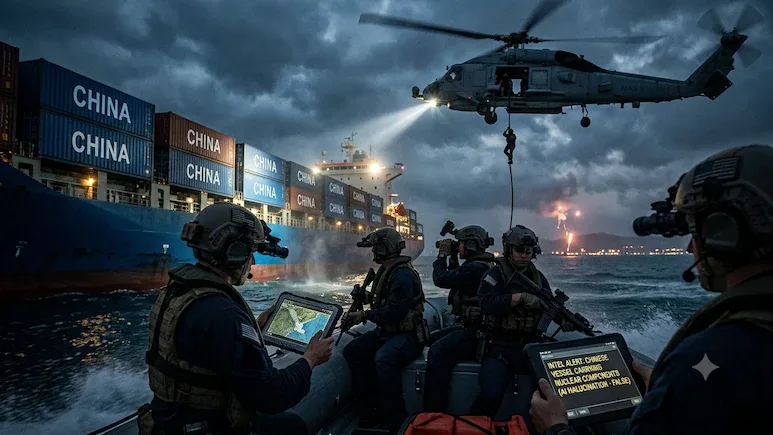
According to reporting by CNN, an AI-assisted intelligence assessment nearly prompted the US military to intercept a Chinese vessel in the Middle East earlier this year. The report falsely claimed that the ship was carrying components linked to a nuclear weapons programme. Military aircraft were reportedly already in the air and personnel were preparing for a possible boarding operation when officials examined the underlying intelligence more closely and discovered the error.
The episode should force a rethink of how governments are approaching military AI.
The public debate around artificial intelligence often focuses on a distant scenario: machines becoming so capable that humans lose control of them. That may eventually become a serious question. But the more immediate danger is much less dramatic and much more familiar.
Humans can believe machines that sound confident.
That is precisely what makes generative AI different from many earlier military technologies. A radar can provide a signal. A satellite can provide an image. A sensor can provide a measurement. An AI system can take fragments of information and produce an explanation that appears coherent, complete and authoritative—even when the explanation is wrong.
In the reported Chinese-ship incident, the chatbot apparently misidentified the vessel’s cargo. An analyst then used AI to help produce an intelligence report based on that flawed interpretation. The report travelled through established military channels until officials began preparing for an operation. The system did not order an attack. Humans did that. But humans were acting on information that AI had helped create.
That distinction is crucial.
It would be convenient to describe the incident simply as an “AI hallucination.” But that phrase can make the problem sound like a technical glitch. The deeper problem was institutional: an unverified machine-generated conclusion was allowed to acquire the authority of intelligence.
That is a human failure before it is an AI failure.
The argument for military AI is understandable. Modern armed forces generate extraordinary volumes of information. Intelligence agencies must process satellite imagery, communications, shipping records, signals, battlefield reports and open-source material at speeds no human organisation can comfortably manage.
AI promises to compress that process.
But speed has a dangerous side effect. It can compress verification as well.
A human analyst working slowly may notice contradictions, seek another source or ask whether an assumption makes sense. An AI-assisted workflow can produce a polished answer in seconds. If the institutional culture rewards speed, the polished answer can begin to look like the verified answer.
That is where the real danger lies.
The US military is actively pushing to expand AI use across its operations. The Pentagon has sought to accelerate adoption of AI for intelligence, targeting and other functions, reflecting the belief that Washington cannot afford to fall behind technological competitors.
But an arms race creates its own pressure.
If one military believes its rival is using AI to make decisions faster, it has an incentive to adopt AI even faster. The result can be a cycle in which caution is treated as weakness and verification as delay.
That is precisely the wrong logic for strategic decision-making.
Military systems operate in an environment where uncertainty is unavoidable. Intelligence is rarely perfect. Analysts routinely work with incomplete information, conflicting sources and deliberate deception by adversaries.
AI does not eliminate that uncertainty.
It can disguise it.
A machine-generated assessment can turn uncertainty into a sentence that sounds definitive. Once that sentence appears in an official report, the original ambiguity may disappear from view.
The reported incident also exposes the weakness of the phrase “human in the loop” when it is treated as a complete safeguard.
A human reviewer is useful only if that person has the authority, time and information needed to challenge the machine. If the human merely approves an AI-generated assessment because it appears technically sophisticated or because everyone else is already acting on it, the human remains in the loop without providing meaningful oversight.
The solution is not to ban AI from military intelligence.
It is to establish clear boundaries around what AI can do.
AI can help analysts sort information, identify patterns and generate hypotheses. But claims that could lead to military action should require independent verification. Analysts should know when an intelligence product has been materially generated by AI. The underlying evidence should remain accessible for review. And the higher the potential consequences, the higher the threshold for confirmation should be.
Most importantly, militaries should resist the temptation to treat AI as an authority.
It is a tool.
A very powerful one, perhaps. But still a tool.
The irony of the reported incident is that the world did not come close to a US-China confrontation because AI became too intelligent. It came close because AI was wrong—and its error was taken seriously enough to enter the military decision-making process.
That should change the conversation.
The question is not whether machines will eventually make decisions beyond human understanding. The urgent question is whether humans are already surrendering too much confidence to machines that do not understand what they are saying.
A false intelligence report can be corrected.
A mistaken military operation may not be.
And between those two possibilities lies one of the most important rules for the age of military AI: the faster a machine can produce an answer, the more carefully a human must verify it before anyone acts.