
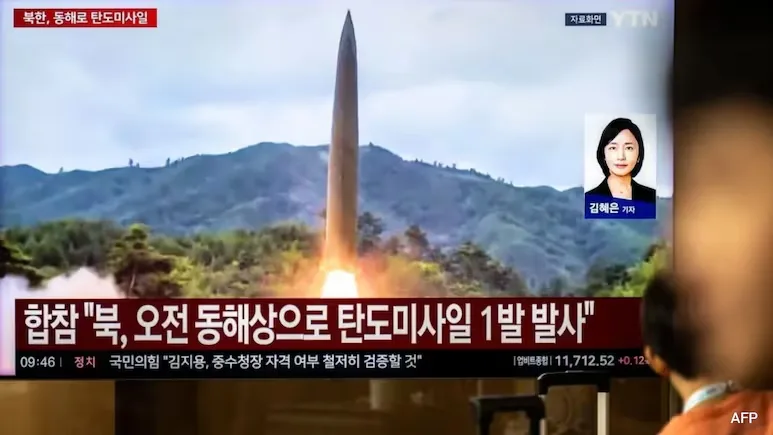
North Korea says it has tested an intermediate-range strategic missile incorporating artificial intelligence that can alter its flight path at low altitude, a claim that points to Pyongyang’s growing effort to combine manoeuvrable missile technology with AI.
The missile was launched from the Wonsan area on Saturday and travelled more than 700 kilometres over the sea before falling into waters off North Korea’s eastern coast, according to South Korea’s military. North Korean leader Kim Jong Un personally oversaw the firing drill, state media said.
Kim Yo Jong, Kim’s sister and a senior ruling-party official, said the missile was capable of changing its trajectory at low altitude and had AI technology incorporated into its system. She claimed the weapon could employ several different flight-path modes depending on its mission and target.
North Korea also claimed that its so-called “wave-like trajectory” made the missile harder for South Korean and Japanese tracking systems to follow. Kim Yo Jong said adversaries had failed to track the missile from its initial manoeuvring points.
Those claims have not been independently verified.
The significance of the test lies less in North Korea’s assertion that it has created an “unavoidable” missile than in the direction of its weapons development. Modern missile defence systems rely on detecting, tracking and predicting an incoming weapon’s trajectory. A missile capable of making significant manoeuvres during flight can complicate each of those stages.
Artificial intelligence could potentially be used to process information from onboard sensors and adjust a missile’s flight path in response to changing conditions. But the extent to which AI was actually responsible for the missile’s reported manoeuvring remains unclear.
Experts have cautioned against accepting Pyongyang’s claims at face value. North Korea has a history of presenting weapons tests in highly ambitious terms, while independent observers often have limited access to verify the technology demonstrated during its launches.
The launch was nevertheless detected by South Korea, the United States and Japan. Seoul said the missile travelled more than 700 kilometres, while Japanese assessments indicated a somewhat shorter distance.
The test came amid a fresh deterioration in relations between North and South Korea. Seoul recently demanded that Pyongyang apologise for a landmine explosion in the Demilitarized Zone that wounded three South Korean soldiers. North Korea has denied responsibility for the blast.
Kim Yo Jong dismissed Seoul’s demand and criticised recent attempts by South Korea’s government to reduce tensions through dialogue. The missile launch followed soon afterwards, reinforcing the perception that Pyongyang remains focused on military pressure rather than engagement.
North Korea has conducted more than 10 missile launches this year, according to available assessments. The country has also been developing manoeuvrable and hypersonic weapons designed to complicate regional missile-defence systems.
The latest test comes as Kim Jong Un has placed greater emphasis on artificial intelligence as part of North Korea’s military modernisation. Analysts have previously noted Pyongyang’s interest in applying AI to drones, surveillance and other weapons systems, although severe technological and economic constraints remain.
North Korea’s cooperation with Russia has also raised questions about whether access to foreign military technology, battlefield experience and technical assistance could accelerate its weapons programmes. The precise extent of any technology transfer related to the latest missile, however, remains unclear.
For South Korea, Japan and the United States, the immediate issue is not whether North Korea has developed a fully autonomous AI weapon, but whether its missile force is becoming more difficult to detect and intercept.
That distinction matters. A missile does not need to possess sophisticated artificial intelligence to pose a greater challenge to missile defences. Even limited improvements in manoeuvrability, guidance and trajectory control can reduce the predictability of an incoming weapon.
North Korea’s latest claim should therefore be treated cautiously, but not dismissed. If Pyongyang can demonstrate that AI-assisted guidance is reliably enabling missiles to change course during flight, it would add another layer of complexity to an already difficult regional missile-defence environment.
For now, however, the missile’s actual AI capabilities, accuracy and ability to defeat existing defences remain unproven. What is clear is that Pyongyang is signalling that artificial intelligence is becoming part of its broader strategy to modernise its missile arsenal.