The visit of a bipartisan US congressional delegation to Dharamshala has brought renewed international attention to a question that Beijing would prefer to keep within its own political framework: who has the authority to determine the future of Tibetan Buddhism?
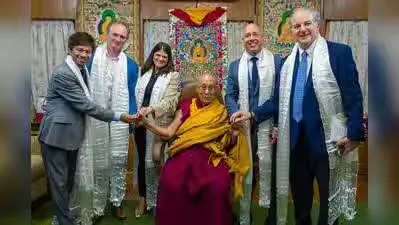
Led by Brian Mast, chairman of the US House Foreign Affairs Committee, the delegation met the 14th Dalai Lama on September 30, 2026. The visit was significant not simply because American lawmakers travelled to the Tibetan exile headquarters in India, but because it demonstrated that the issue of Tibet continues to command attention across the political divide in Washington.
The delegation included James Gallagher, Jimmy Patronis, Shri Thanedar and Haley Stevens. Their presence reflected a bipartisan interest in Tibet at a time when the question of the Dalai Lama’s succession is becoming increasingly consequential.
At the centre of the dispute is a fundamental disagreement over religious authority. The Dalai Lama has maintained that the process of identifying his successor must follow Tibetan Buddhist traditions and has placed responsibility for overseeing the institution’s continuation with the Gaden Phodrang Trust. Beijing, by contrast, insists that the selection must conform to Chinese regulations and receive state approval.
These positions are not merely competing administrative interpretations. They represent two fundamentally different ideas about the relationship between religion and political power. For Tibetan Buddhists, the succession of the Dalai Lama is a spiritual matter rooted in centuries of religious tradition. For the Chinese Communist Party, it is also an issue of political authority over a territory it considers inseparable from the Chinese state.
That conflict makes the succession question much larger than the future of one religious leader. It concerns whether a religious community can preserve its institutions and traditions without political authorities determining their leadership.
China’s record in the selection of Tibetan Buddhist figures has intensified these concerns. The disappearance of Gedhun Choekyi Nyima, recognised by the Dalai Lama as the 11th Panchen Lama in 1995, and Beijing’s subsequent recognition of another candidate remain central to Tibetan apprehensions about state intervention in religious affairs. The episode has become a powerful reference point in the current succession debate.
The Dalai Lama’s decision to entrust the succession process to the Gaden Phodrang Trust is therefore an attempt to establish institutional continuity beyond his lifetime. It also places the responsibility for preserving the religious tradition within an institution associated with the Tibetan Buddhist community rather than leaving the process open to unilateral political direction.
The American delegation’s visit gives this position additional international visibility. Mast has raised concerns about possible Chinese interference in the succession process and allegations of pressure against Tibetans beyond China’s borders. Such concerns should be understood as allegations requiring scrutiny, but they underline why the issue has attracted attention beyond the Tibetan exile community.
The significance of the visit also lies in its bipartisan character. Support for Tibetan religious freedom is not confined to one faction in American politics. The participation of lawmakers from both parties suggests that the question remains part of a wider discussion about human rights, religious autonomy and China's international conduct.
For India, Dharamshala gives this debate a particular dimension. The town has served as the centre of the Tibetan government-in-exile and the Dalai Lama’s residence since his arrival in India in 1959. It has become an important centre of Tibetan religious, cultural and institutional life. India’s role as host to the Tibetan exile community places it in a distinctive position, even as it must balance that responsibility with the wider complexities of its relationship with China.
The international debate, however, should not be reduced to a contest between Washington and Beijing. Tibet’s religious future cannot be treated simply as another instrument in great-power competition. The central question is whether Tibetan Buddhists will be able to determine the leadership of their own spiritual tradition in accordance with its established beliefs and practices.
Beijing may seek to establish political control over the succession process, but state authority does not automatically confer religious legitimacy. Recognition imposed through administrative power may satisfy a government’s political objectives without securing the acceptance of the community whose faith is involved.
The Dharamshala meeting does not resolve this dispute, nor does it guarantee that international pressure will alter China’s position. Its importance lies in keeping the issue visible and making clear that the succession of the Dalai Lama is not a matter that can be settled solely through a decision in Beijing.
As the Tibetan community prepares for a future beyond the present Dalai Lama, the international community faces a test of consistency. If religious freedom is to mean more than a diplomatic principle, it must include the right of religious communities to preserve their traditions and choose their spiritual leaders without political coercion.
Tibet’s future will ultimately be shaped by the resilience of its people and institutions. But the international response will help determine whether their religious autonomy remains a recognised principle or becomes another casualty of political control.