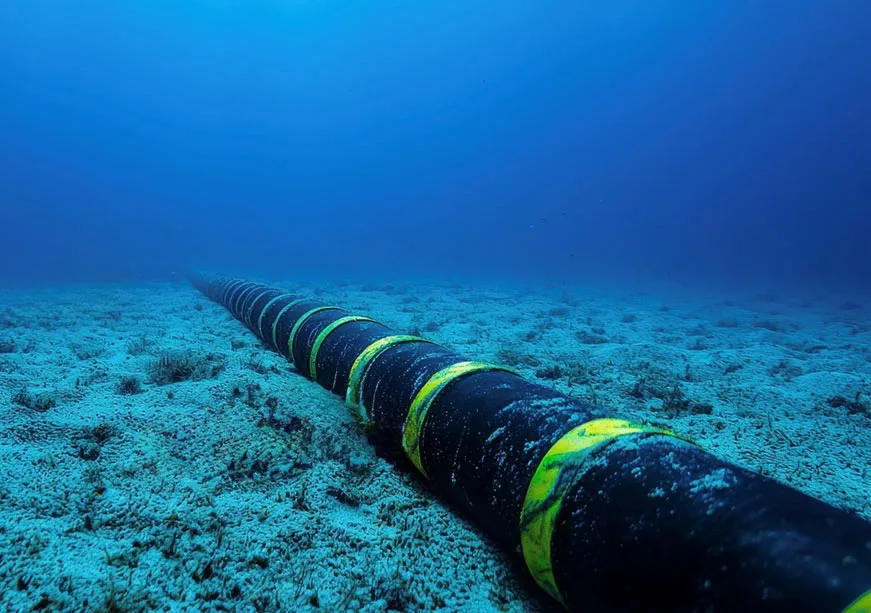
The next major front in the US-China technology rivalry may not be found in semiconductor factories, artificial intelligence laboratories or satellite networks. It is increasingly taking shape on the ocean floor, where submarine cables carry the data that sustains the global economy.
In a Bloomberg Opinion article, Ruth Pollard argues that the contest over undersea cables is reshaping the digital architecture of Southeast Asia. Governments and technology companies are reconsidering where these cables should run, who should build them and which countries should be trusted to maintain them. The choices are no longer driven by cost and engineering alone. They are increasingly determined by strategic calculations about security, access and geopolitical risk.
The stakes are substantial. Submarine cables carry more than 95 per cent of global data flows and support trillions of dollars in daily financial transactions. They underpin international communications, cloud services, financial markets and the digital operations of governments and businesses. Their physical vulnerability, combined with their strategic importance, makes them an increasingly prominent concern for national security planners.
For years, undersea cable networks were largely treated as commercial infrastructure. That assumption is becoming difficult to sustain as US-China competition reaches deeper into the systems that connect economies and transmit information.
The South China Sea has emerged as a particularly sensitive arena. Beijing’s maritime presence, regulatory controls and permitting requirements have complicated the construction and repair of cable infrastructure in contested waters. According to Pollard’s account, these obstacles have encouraged some operators to abandon planned routes or redesign projects to avoid the area.
Such decisions carry consequences beyond individual companies. Cable routes determine which countries become important digital gateways, where data traffic flows and which economies gain easier access to international networks. Infrastructure built today can shape regional connectivity for decades, giving the competition an enduring strategic dimension.
The Strait of Malacca presents a related challenge. The narrow maritime corridor between Indonesia, Malaysia and Singapore is one of the Indo-Pacific’s most important passages for global trade. Its concentration of submarine cables creates a potential vulnerability: disruption at a critical point could affect multiple connections simultaneously.
Technology companies are responding by seeking alternative routes, even when those options are more expensive or technically less attractive. Google’s TalayLink project, for example, is planned to connect Australia and Thailand through the Indian Ocean along a route west of the Sunda Strait. The Echo cable, developed by Google and Meta, links the United States and Singapore through Guam and Indonesia, reflecting the effort to build connectivity that reduces exposure to China.
These choices illustrate how commercial infrastructure is being reorganised around geopolitical boundaries. Companies are accepting additional costs in exchange for routes they consider less exposed to strategic pressure. The resulting networks may be more diversified geographically, but they also risk fragmenting the once relatively integrated architecture of global connectivity.
Washington and Beijing both view foreign control of communications infrastructure through a security lens. The United States has sought to limit the involvement of Chinese suppliers in sensitive cable projects, arguing that their participation could create opportunities for surveillance or disruption. China, in turn, has raised concerns about American and Japanese technology.
The rivalry is therefore not simply a contest between secure and insecure equipment. It is also a struggle over who sets the standards, supplies the technology and gains influence over the networks through which information moves. Security concerns are genuine, but they can also become instruments for excluding competitors and consolidating national influence.
The history of Huawei Marine Networks illustrates the shift. Under growing US scrutiny, Huawei agreed in 2019 to sell its controlling stake in the business to China’s Hengtong Optic-Electric. The company was subsequently renamed HMN Technologies. Yet concerns about its ownership and technological origins have continued to influence how the United States and its partners approach Chinese participation in subsea cable projects.
For Southeast Asian countries, this creates a difficult balancing act. They need reliable, affordable digital infrastructure and investment from competing technology powers. But they also face pressure to align with one side or the other as the strategic importance of connectivity grows.
The temptation will be to treat cable security as a binary choice: accept Chinese participation and risk exposure to Beijing, or exclude Chinese suppliers and rely on Western-backed alternatives. That approach risks overlooking the need for independent assessments, transparent procurement and diversified infrastructure. A system built around a single dominant supplier or a narrow set of routes can remain vulnerable, regardless of the supplier’s nationality.
The next stage of the competition is likely to extend beyond cables to the data centres that store and process information. A country may secure a connection to the global internet while remaining dependent on foreign companies for the computing capacity that gives that connection economic value. Control over digital infrastructure therefore extends from the seabed to the facilities where data is managed and turned into commercial or strategic advantage.
Japan could play a significant role in reducing these dependencies. It is a major supplier of subsea cable technology and an important connectivity hub between North America and Asia. Greater cooperation with Australia, the United States and India through the Quad, alongside engagement with the Association of Southeast Asian Nations, could help expand cable-laying capacity and strengthen regional resilience.
For India, the implications are particularly relevant. As a major Indo-Pacific power with growing digital ambitions, India has an interest in secure international connectivity, diversified routes and a regional architecture that does not leave critical infrastructure concentrated in a few strategic chokepoints. Cooperation with partners can support these goals, but strategic autonomy will require more than choosing preferred foreign suppliers. It will depend on technical capacity, credible security standards and the ability to participate in the development of regional infrastructure.
The objective should be to build redundancy rather than merely shift dependence from one geopolitical bloc to another. Alternative routes, multiple suppliers, effective repair arrangements and stronger regional coordination can reduce the impact of disruptions. Transparent rules can also help prevent security concerns from becoming a blanket justification for political exclusion.
There is an important paradox in the current contest. Efforts to reduce dependence on China may strengthen the position of a small number of American technology companies, giving them greater influence over where critical networks are built and how digital traffic is routed. Replacing one concentration of power with another does not necessarily produce a more resilient system.
The undersea technology contest is therefore about more than protecting cables from sabotage. It is about the future distribution of digital power in the Indo-Pacific. Governments must secure the infrastructure on which their economies depend without allowing geopolitical rivalry to dictate every commercial and technological decision.
The cables laid today will shape the region’s connectivity long after current political tensions have changed. The real measure of success will not be whether one power excludes another from every route, but whether countries build networks that are secure, diversified and resilient enough to withstand pressure from any direction.