The economic reach of Pakistan’s military-affiliated institutions is often discussed in terms of factories, banks and large financial figures. Yet the most immediate consequences may be felt in rural communities and by families seeking healthcare, education and stable livelihoods. The supplied report presents both sides of this story: extensive welfare delivery and enduring disputes over agricultural land.
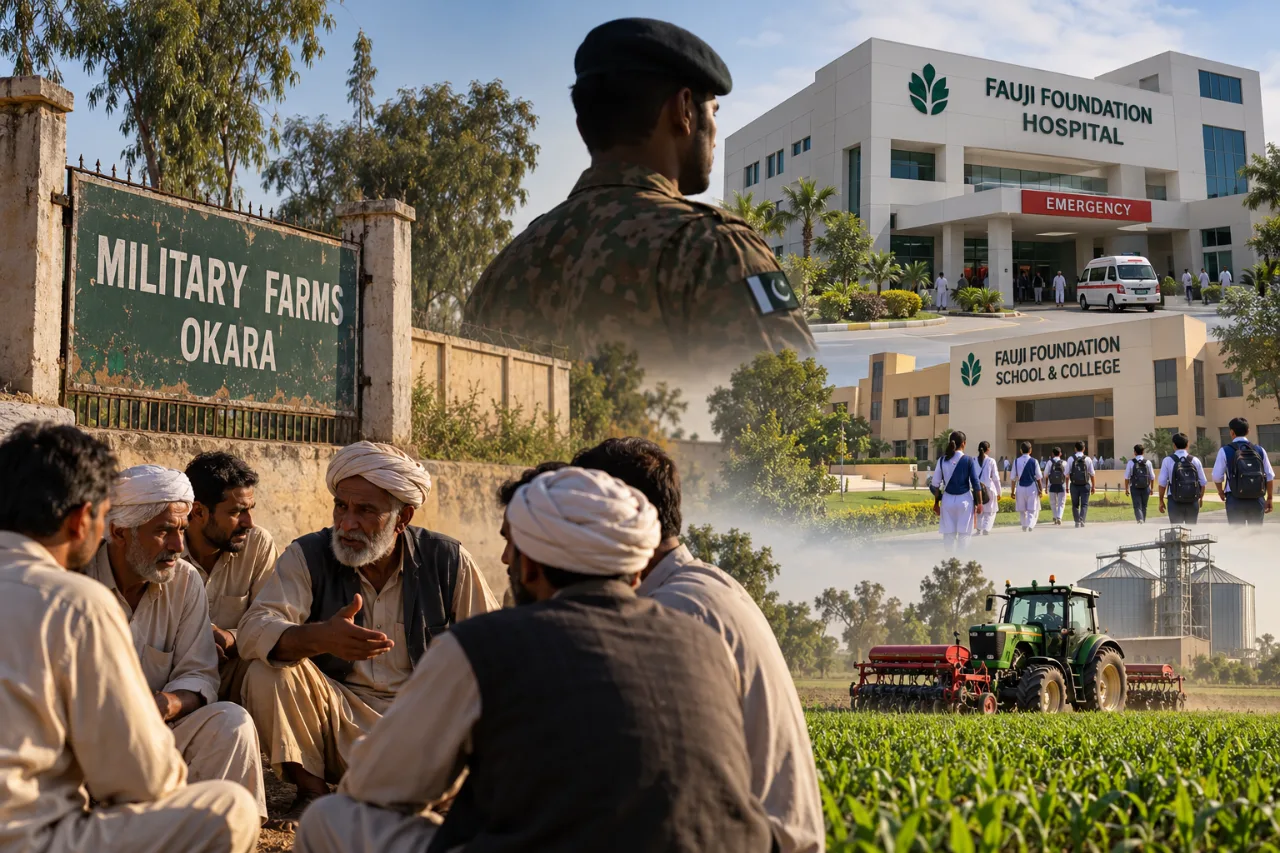
In Okara, Punjab, military farms covering approximately 17,000 acres became the center of a long-running conflict between administrators and tenant farmers. The report traces the farms to colonial-era stud and fodder operations, where cultivators worked under a crop-sharing arrangement known as batai. In 2000–2001, efforts to shift tenants toward cash-contract leases prompted resistance organized through Anjuman Mozareen Punjab. Tenant families asserted claims rooted in generations of cultivation.
A particularly important detail in the report concerns a December 2018 hearing before Pakistan’s National Commission for Human Rights. It states that the commandant of the Okara Military Farm Group acknowledged that the Punjab provincial government, not the army, held legal title to the land. This distinction does not by itself settle every tenant claim, but it underscores why public land management, tenancy rights and administrative authority require careful legal scrutiny.
The report also distinguishes Okara’s institutional farm model from private commercial agriculture in neighboring Pakpattan. It describes private seed multiplication, mechanized farming and family-run estates there. The comparison matters: the presence of retired military personnel in a private agricultural business does not, on its own, establish institutional military ownership or control. Analytical precision is essential when evaluating land-related allegations.
Alongside these controversies, the report credits Fauji Foundation with a substantial healthcare and education network: approximately 80 medical facilities, treatment for more than 3.7 million patients annually and over 122 schools and colleges serving more than 70,000 students. These reported welfare outcomes deserve recognition, while their scale and beneficiaries should be verified through current institutional disclosures.
The underlying policy challenge is to protect both welfare beneficiaries and civilian rights. Clear land records, fair tenancy procedures, transparent charitable spending and accessible grievance mechanisms would help address it. A system that supports veterans while respecting farmers, taxpayers and private competitors would be stronger than one in which economic influence and public accountability remain difficult to disentangle.