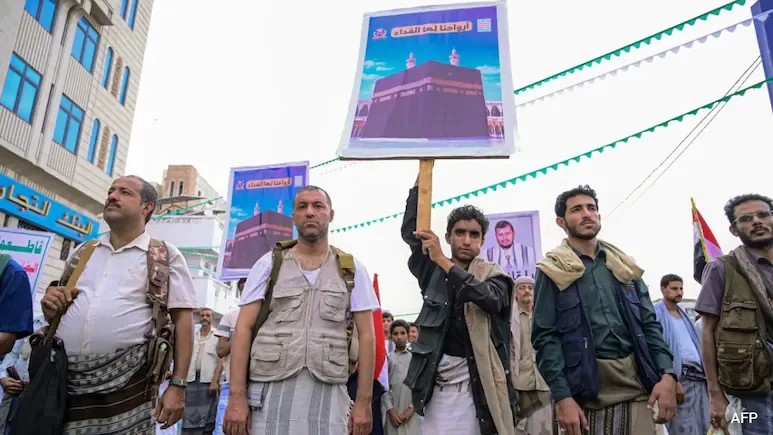
The Houthis have found an unusual weapon in their confrontation with Saudi Arabia: the Jeffrey Epstein files. Rather than relying solely on missiles, drones and battlefield operations, the Iran-aligned Yemeni movement is using the scandal surrounding the late American sex offender to attack the Saudi leadership’s religious credibility and political standing.
The strategy is deliberate. Saudi Arabia’s identity as the guardian of Islam’s holiest sites is central to its regional influence. By amplifying reports that associates of the Saudi royal court arranged for Epstein to receive textiles that had once covered the Kaaba in Mecca, the Houthis are attempting to turn a controversy involving powerful individuals into a broader indictment of the kingdom’s leadership.
The allegations and their political interpretation must be distinguished. Reports concerning the textiles do not, by themselves, establish collective responsibility on the part of the Saudi state or prove every accusation made by the Houthis. But in information warfare, the political impact of a claim can extend well beyond what the available evidence establishes.
That is precisely what makes this campaign significant. The Houthis are seeking to weaken Saudi Arabia not only by challenging its military position, but by questioning the moral authority on which part of its regional influence rests.
Turning Religious Authority Into a Vulnerability
Saudi Arabia occupies a distinctive position in the Muslim world because it is home to Mecca and Medina, Islam’s two holiest cities. The kingdom’s custodianship of the holy sites gives it religious prestige that extends beyond its borders and reinforces its standing among Muslim-majority countries.
That position also creates a vulnerability. Allegations involving the misuse of sacred objects or connections between influential figures and a scandal associated with sexual exploitation can carry consequences far beyond ordinary political criticism.
The Houthis have sought to exploit that sensitivity. After Saudi Arabia accused the movement of targeting the Mecca and Medina regions with a drone, the Houthis denied the allegation and turned the charge back against the kingdom. Their messaging invoked the reports about the textiles sent to Epstein, presenting the controversy as evidence of hypocrisy among those who claim to protect Islam.
The tactic is designed to reverse the moral framing of the confrontation. Instead of allowing Saudi Arabia to present itself as the defender of the holy sites against Houthi aggression, the movement seeks to cast the kingdom’s own leadership as unworthy of that role.
This does not make the Houthi movement a credible or impartial guardian of religious values. Its messaging serves a clear political and military purpose. But it shows how religious legitimacy can become a contested front in a regional conflict.
The contest is not simply over what happened. It is over who has the authority to define the meaning of the allegations and whose account the public is prepared to believe.
Information Warfare Beyond the Battlefield
The Houthi campaign reflects a broader change in the conduct of modern conflict. Armed movements increasingly treat digital communication as an operational tool, using social media, videos, speeches, music and online personalities to extend the reach of their political messaging.
According to reporting by The New York Times, the Houthis have developed a media network that includes television, websites, radio, newspapers and official and unofficial social media accounts. Ideologically aligned cultural figures also help amplify messages beyond the movement’s formal structures.
This network allows the group to respond quickly to news events and recast them in terms that support its political narrative. A document release, a public controversy or an opponent’s statement can be repackaged into a video, song or viral post. The objective is to keep the message circulating across different audiences and platforms.
The Epstein controversy is particularly useful for this purpose because it already carries international recognition and associations with elite privilege, secrecy and alleged misconduct. The Houthis do not need to create public interest in the scandal. They need to connect it to their existing argument that powerful governments and their allies operate by standards different from those imposed on ordinary people.
This is a form of narrative opportunism: a movement takes an existing controversy and integrates it into a larger campaign against an adversary.
The effectiveness of such messaging should not be confused with the truth of its broader claims. Repetition and emotional resonance can make a political narrative influential without establishing that its conclusions are justified.
Saudi Arabia’s Yemen Problem
The campaign also draws on a deeper history of hostility between Saudi Arabia and the Houthis.
Saudi Arabia led a military intervention in Yemen in 2015 in support of the internationally recognised Yemeni government against the Houthi movement. The intervention contributed to a devastating humanitarian crisis, with civilians suffering from violence, hunger, disease and the collapse of essential services.
That history gives the Houthis a reservoir of grievances to draw upon. They can frame their confrontation with Riyadh not only as a struggle over power in Yemen, but as resistance to a regional order they portray as dependent on foreign military support and indifferent to civilian suffering.
The reports concerning Epstein and the Kaaba textiles provide a new theme for an established argument. The movement is attempting to connect the Saudi leadership to a scandal involving powerful American circles while reminding audiences of the kingdom’s role in the Yemen war.
The combination is politically useful. It links allegations about elite conduct to memories of military intervention and civilian suffering, presenting both as evidence against Saudi authority.
Yet the Houthis’ own record and political objectives must remain part of the assessment. Their use of humanitarian grievances does not erase their responsibility for their own actions, nor does it turn their media campaign into a neutral effort to defend Yemeni civilians.
A propaganda campaign can draw upon real grievances while selectively presenting facts to serve a political objective. Recognising the underlying grievances does not require accepting the conclusions promoted by the group exploiting them.
Iran’s Wider Information Strategy
The Houthi messaging also fits within a broader regional information contest involving Iran and groups aligned with Tehran. Such movements frequently frame their conflicts as part of a wider struggle against American and Israeli influence, linking local disputes to a common ideological narrative.
Epstein’s name offers a particularly adaptable symbol within that framework. The scandal can be used to portray Western elites as corrupt and to suggest that political power, wealth and alleged misconduct are intertwined. Houthi leaders have invoked the files in speeches criticising the United States and Israel, while their media network has applied the same framing to Saudi Arabia.
This approach seeks to collapse distinctions between different governments and political actors into a single adversarial category. Saudi Arabia’s security relationship with Washington becomes part of the argument, even though the kingdom has no diplomatic relations with Israel.
The purpose is to undermine the legitimacy of Saudi policy by associating Riyadh with the movement’s principal enemies. It is an effort to make political alignment appear to be evidence of shared moral responsibility.
That framing is powerful precisely because it simplifies a complicated regional landscape. But Saudi-US cooperation, the Yemen conflict and allegations emerging from the Epstein files are separate matters that require evidence-based examination. Their appearance in the same political narrative does not establish that every implied connection is valid.
The broader lesson is that information warfare often works by linking distinct events until they appear to confirm one another. Audiences are encouraged to accept a sweeping conclusion without examining the evidence supporting each individual claim.
The Limits of the Houthi Strategy
The campaign may damage Saudi Arabia’s reputation among some audiences, particularly those already critical of the kingdom’s regional policies. But its wider impact is difficult to measure, and the movement’s ability to circulate a message does not guarantee that it will persuade those who encounter it.
Saudi Arabia retains considerable diplomatic, economic and religious influence. The kingdom’s standing cannot be reduced to a single controversy, and allegations involving individuals associated with its royal court should not automatically be treated as proof of institutional wrongdoing.
The Houthis also face a credibility problem of their own. Their attempt to present themselves as defenders of Islam is inseparable from their struggle to consolidate power in Yemen and their wider ideological alignment with Iran. Audiences may accept their criticism of Saudi Arabia without accepting the movement’s broader claims to moral authority.
The campaign’s significance therefore lies less in whether it can deliver an immediate strategic victory than in what it reveals about the changing methods of political conflict.
A movement with limited conventional resources can still challenge a wealthier adversary by exploiting sensitive issues, adapting to online attention and turning an opponent’s vulnerabilities into recurring political themes.
For Saudi Arabia, responding effectively requires more than dismissing the campaign as propaganda. It means addressing legitimate questions transparently, separating verifiable facts from political allegations and recognising that religious prestige does not eliminate the need for public accountability.
It also means resisting the temptation to answer every accusation with counter-messaging. Where claims are false, evidence and clear rebuttals matter. Where questions are legitimate, silence or blanket denials can leave space for adversaries to shape the narrative.
The New Front in Regional Rivalry
The Houthis’ use of the Epstein files demonstrates how the boundaries between military conflict, political communication and reputational warfare have blurred. A scandal originating far from Yemen has become material for a campaign aimed at one of the movement’s principal regional adversaries.
Missiles and drones can inflict immediate physical damage. Information campaigns operate differently: they seek to weaken trust, fracture alliances and undermine the legitimacy that allows governments to exercise influence.
Neither form of conflict should be assessed in isolation. The Houthi campaign draws strength from the military history of the Yemen war, existing hostility towards Saudi Arabia and the global attention surrounding Epstein. Its messaging is most effective when it connects these elements into a single story about corruption and hypocrisy.
But the public should not mistake a compelling narrative for a proven case. Reports about the textiles, allegations concerning individuals and the Houthis’ political interpretation are distinct questions. Each requires scrutiny on its own merits.
The strategic lesson is clear. In a region where religious legitimacy, political authority and military power are closely intertwined, the contest for credibility can be as consequential as the contest for territory. The Houthis understand that a controversy capable of undermining an adversary’s moral standing can become a weapon far beyond its original context.
The challenge for Saudi Arabia—and for audiences following the conflict—is to separate evidence from insinuation without ignoring legitimate questions. In modern information warfare, the decisive advantage often belongs not to the side that produces the loudest accusation, but to the side that can sustain its credibility under scrutiny.