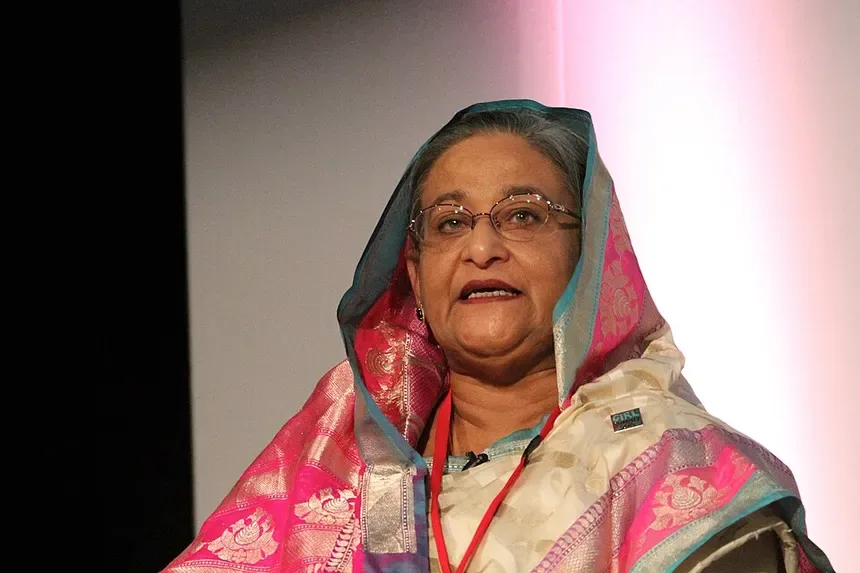
DHAKA — Former Bangladesh prime minister Sheikh Hasina has called for the restoration of democratic rights, political participation and the rule of law in Bangladesh, saying the country is facing a deep crisis of governance, security and public confidence.
Hasina, who is living in New Delhi and faces a death sentence in Bangladesh, made the remarks while addressing an online seminar in London focused on democracy, rights and the rule of law.
“We must restore the democratic rights and economic emancipation of the people of Bangladesh, give them back their voice and ensure that the future of Bangladesh is decided by the people of Bangladesh themselves,” Hasina said.
She said restoring those rights was her responsibility and reiterated her intention to return to Bangladesh in December. Hasina has previously said she intends to return despite the legal proceedings against her.
Her remarks come more than two years after she left Bangladesh following the mass uprising that ended her long tenure as prime minister in August 2024. She has since remained in India.
Hasina described Bangladesh as being confronted by renewed threats from militancy and violent extremism, while accusing the authorities of weakening democratic institutions and public security.
She argued that the country needed political participation and constitutional governance rather than further confrontation. Her comments were delivered as the political environment in Bangladesh remains contested following the transition that followed her departure.
Hasina's Awami League has been barred from political activity, while she herself has faced prosecution over allegations arising from the violence surrounding the 2024 uprising. She has rejected the proceedings and the death sentence against her.
The former prime minister also criticised what she described as the erosion of the rule of law and political rights. She said Bangladeshis should be able to determine the country's political future through democratic participation.
Her call for a restoration of democracy comes after Bangladesh held parliamentary elections in February 2026, following the political transition that began after her removal from office. The Bangladesh Nationalist Party returned to power, while the Awami League remained excluded from the electoral contest.
Hasina's supporters continue to argue that the Awami League should be allowed to participate in national politics. The party's exclusion remains one of the most contentious issues in Bangladesh's post-2024 political order.
Her remarks also come amid continuing debate over accountability for the violence that accompanied the fall of her government. Hasina and senior members of her administration have faced allegations concerning the use of force against protesters. She has denied responsibility for the accusations and has described the legal proceedings against her as politically motivated.
International rights organisations have documented serious abuses during the 2024 unrest, including killings and excessive use of force. At the same time, rights groups have also raised concerns over arbitrary arrests and other abuses following Hasina's departure.
Speaking from India, Hasina said she remained in contact with people inside Bangladesh despite being away from the country for more than two years. She said the political future of Bangladesh should ultimately be decided by its citizens.
She also linked political rights to economic security, arguing that democratic participation and economic emancipation were closely connected.
Hasina's planned return remains uncertain. She faces a death sentence in Bangladesh, and the authorities there have sought legal action against her. Any return would therefore carry significant legal and political consequences.
Her latest remarks nevertheless indicate that she intends to remain politically engaged and continue pressing for the restoration of the Awami League's political role.
The former prime minister's intervention adds to an ongoing debate over Bangladesh's political direction following the upheaval that ended her 15-year rule. While the country's new political order has been established through elections, questions remain over the status of the Awami League, accountability for the 2024 violence and the future participation of Hasina herself.
For Hasina, the message remains centred on political rights, constitutional order and the return of democratic participation. She said she would not abandon that objective and plans to explain in greater detail how she intends to return to Bangladesh later this year.