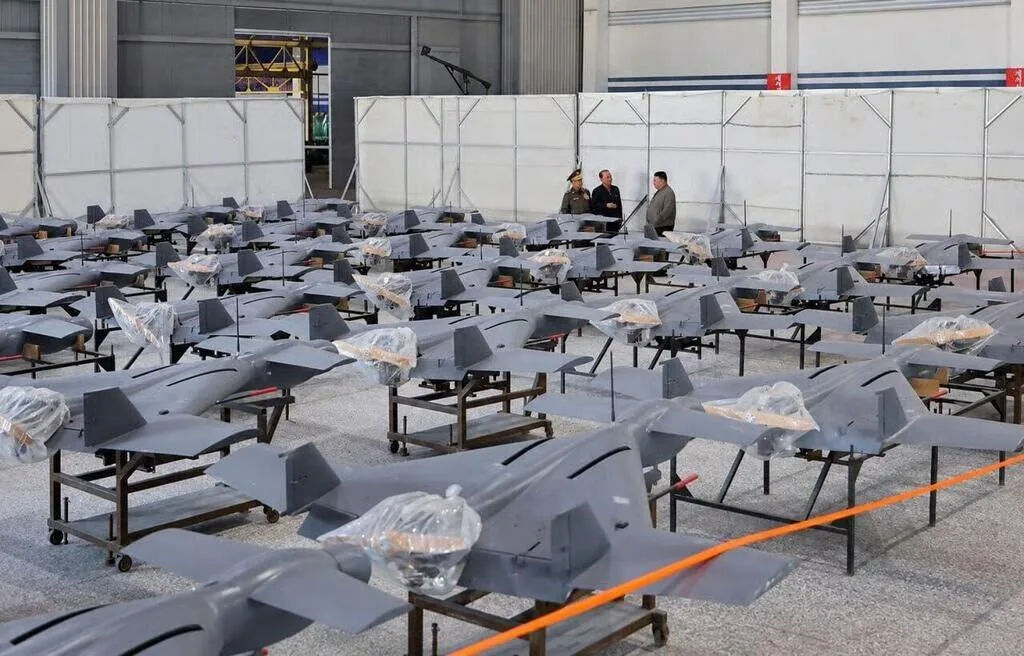
The military balance on the Korean Peninsula is entering a new phase as North Korea combines its expanding missile capabilities with a growing emphasis on unmanned warfare. For South Korea, the challenge is not simply to acquire more advanced weapons. It is to develop the intelligence, surveillance and defensive capacity needed to identify and respond to a more dispersed, mobile and difficult-to-predict threat.
For decades, the strategic contest between the two Koreas has been shaped by North Korea’s artillery, ballistic missiles and nuclear weapons, alongside South Korea’s technological advantages and its alliance with the United States. That framework remains central to regional security. But the proliferation of relatively inexpensive attack drones is adding another layer of complexity to an already dangerous confrontation.
The experience of Ukraine and recent conflicts in the Middle East has demonstrated how drones can complement conventional missiles, expose gaps in air defences and force defenders to expend costly interceptors against comparatively inexpensive weapons. North Korea appears to be drawing lessons from these conflicts as it develops systems designed to expand its ability to strike targets across the peninsula.
The result is a changing military equation. Pyongyang does not need to match every South Korean or American technological advantage to complicate their defence planning. It can seek to exploit the gaps between detection, decision-making and interception.
North Korea’s Strategy of Asymmetry
North Korea has long relied on asymmetric military capabilities to offset South Korea’s stronger economy, more advanced conventional forces and close defence relationship with Washington. Its nuclear arsenal and ballistic missile programme remain the most consequential elements of that strategy.
Drones offer another way to pursue the same objective.
Their relatively low production costs, operational flexibility and potential for deployment in large numbers make them attractive to a country seeking to impose substantial defensive costs on a technologically superior opponent. Depending on their design, drones can support reconnaissance, identify targets, carry weapons or operate alongside other strike systems.
North Korea has developed a range of unmanned aircraft over several decades and publicly displayed more advanced reconnaissance and multi-role platforms in 2023. Leader Kim Jong Un has also emphasised the production and operational use of attack drones.
The significance of this development lies less in any single aircraft than in how unmanned systems could be integrated with existing capabilities. A combination of drones, cruise missiles, ballistic missiles, rockets and conventional artillery could confront South Korean forces with several different threats at once.
Each system presents a different detection and interception problem. A defender must distinguish genuine attacks from other activity, assess which incoming weapons pose the greatest danger and allocate limited resources accordingly. When multiple systems arrive in overlapping waves, the decision-making burden becomes more demanding.
Such a strategy does not guarantee that an attack would succeed. South Korea retains substantial military advantages, including sophisticated aircraft, advanced sensors and layered missile-defence capabilities. But the increasing diversity of North Korean strike systems could make it harder to translate those advantages into a reliable defence against every potential threat.
The Limits of Missile Defence
South Korea has invested heavily in a strategy intended to deter and, if necessary, respond to a North Korean attack. Its three-axis framework combines the capacity to strike threatening missile facilities, missile-defence systems designed to intercept incoming weapons, and overwhelming retaliation against North Korean military targets.
The approach depends on timely and accurate intelligence.
South Korean forces must be able to locate mobile missile launchers, monitor relevant military facilities, identify signs of an impending attack and assess incoming threats quickly enough to act. These requirements become more difficult when an adversary can disperse its equipment, conceal its launch platforms and use relatively inexpensive unmanned systems to complicate surveillance.
North Korea’s geography and military infrastructure add to the challenge. Its forces have developed hardened facilities and mobile platforms, while its artillery positions and missile systems place substantial pressure on South Korea’s ability to anticipate an attack.
The problem is not that South Korea lacks sophisticated weapons. It is that even advanced weapons depend on the information available to the forces operating them. A missile interceptor cannot engage a threat that has not been detected and tracked in time. An offensive strike cannot reliably neutralise a mobile target whose location is uncertain.
South Korea has been expanding its intelligence, surveillance and reconnaissance capabilities, including through unmanned aircraft and satellites. Yet these investments take time to mature, and persistent surveillance across a heavily militarised adversary remains difficult.
The emergence of larger drone salvos adds another demand to this system. Defences designed primarily around conventional aircraft, artillery and ballistic missiles may need additional sensors, suitable interceptors and revised procedures to address a broader range of unmanned threats.
This does not mean that South Korea’s defensive architecture has become ineffective. It means that its performance cannot be judged solely by the sophistication of individual weapons. The more important measure is whether the entire system can detect, interpret and respond to multiple threats under pressure.
The Cost Imbalance Matters
The economic dimension of drone warfare is particularly important for the Korean Peninsula.
Advanced interceptors, radar systems and high-performance aircraft require substantial investment. Many attack drones, by contrast, can be produced at comparatively low cost, although their price and effectiveness vary considerably by design and mission.
This creates a difficult calculation for the defender. Using an expensive interceptor against a low-cost drone may be justified when the target threatens a critical facility or when no other effective response is available. But repeating that exchange across a large number of incoming weapons can place pressure on inventories, budgets and replenishment schedules.
The challenge is not simply to find a cheaper interceptor for every drone. Different threats require different responses, and low-cost systems may not be suitable against every target. Effective defence is likely to depend on a combination of electronic warfare, surveillance, specialised short-range systems, conventional air defence and more expensive interceptors reserved for threats that demand them.
South Korea must also consider the possibility that North Korea could use drones to complicate the response to missile attacks. Even if many unmanned aircraft were intercepted, their presence could consume attention and defensive resources while more dangerous weapons remained in the air.
The central strategic issue is therefore one of cost, scale and coordination. A defender that relies too heavily on a small number of expensive capabilities may find it difficult to sustain an effective response during a prolonged or complex attack.
The Danger of Overestimating the New Threat
North Korea’s advances should not obscure the substantial constraints it faces.
Developing a prototype is not the same as producing a reliable weapon in large numbers. Demonstrating a system during a controlled test does not establish that it can operate effectively in a contested environment. Nor does the public display of a drone or missile prove that it has been integrated successfully into operational units.
Questions remain about the reliability, precision, communications resilience and effectiveness of North Korea’s unmanned systems under real combat conditions. The country's limited economic resources and technological constraints may affect its ability to sustain large-scale production, maintenance and operational deployment.
South Korea also retains important advantages in conventional air power, surveillance technology and military integration with the United States. Its ability to adapt should not be underestimated.
The correct conclusion is not that North Korea has overturned the military balance. Rather, it has acquired additional means of exploiting existing vulnerabilities, and those means could become more consequential as their numbers, reliability and integration improve.
That distinction matters for defence planning. Treating every new North Korean capability as a decisive breakthrough risks distorting procurement priorities. Dismissing inexpensive drones as a secondary concern, however, could leave gaps that an adversary might exploit.
South Korea needs evidence-based assessments of what North Korea can field, how reliably it can employ those systems and which defensive weaknesses are most urgent to address.
Wartime Operational Control and Alliance Planning
The changing threat also has implications for South Korea’s ambition to assume wartime operational control of allied forces on the peninsula.
The transfer of wartime operational control from the United States to South Korea has long been linked to Seoul’s ability to lead combined operations and meet agreed military capability requirements. The debate is therefore about more than a formal change in command arrangements. It concerns the practical capacity to coordinate intelligence, targeting, air and missile defence, logistics and joint decision-making during a crisis.
The growing importance of drones and mobile missile systems makes these requirements more demanding. South Korea would need reliable surveillance and information-sharing capabilities, the ability to track changing threats and the capacity to coordinate responses across different military services.
These requirements do not automatically justify delaying the transition. Nor should a political timetable override objective assessments of military readiness. The two allies need to evaluate the capabilities required for effective command and agree on how remaining gaps will be addressed.
The United States will continue to play a consequential role in regional deterrence, particularly through intelligence, advanced military capabilities and the broader alliance structure. But greater South Korean capacity to monitor and respond to threats would strengthen the alliance regardless of the precise timetable for command transition.
The priority should be measurable readiness rather than a symbolic contest over deadlines. Operational control is meaningful only if the command structure is supported by the information, capabilities and coordination needed to function under the conditions of a real crisis.
Deterrence Must Adapt Before a Crisis
The military competition on the Korean Peninsula is increasingly defined by the interaction of nuclear weapons, missiles, conventional firepower, drones and intelligence systems. The addition of unmanned aircraft does not replace the existing deterrence framework. It makes that framework more complicated.
For North Korea, drones offer a potential means of expanding its strike options without matching South Korea and the United States across every technological category. For South Korea, they expose the limits of a strategy that depends on locating and destroying threats before those threats can inflict damage.
The response requires more than an accelerated weapons-buying programme. South Korea needs resilient surveillance, improved coordination between intelligence and defence systems, a diversified mix of counter-drone capabilities and sufficient stocks to sustain operations. It must also continue testing how these systems perform when confronted with multiple, overlapping threats rather than isolated targets.
The United States has a parallel interest in ensuring that its regional posture can support South Korea under increasingly complex conditions. Intelligence-sharing, joint exercises and the integration of defensive capabilities will remain important, but they must evolve as the threat changes.
Ultimately, drones and missiles are not rewriting the Korean Peninsula’s military balance simply because one side has developed new weapons. They are changing the conditions under which existing advantages can be used.
The side that can detect threats earlier, maintain a clearer picture of the battlefield, coordinate its response and sustain its defences will be better positioned to preserve deterrence. North Korea’s growing arsenal makes that task harder for South Korea, but it does not make the outcome inevitable.
The most dangerous assumption would be that technological superiority alone guarantees security. On the Korean Peninsula, deterrence will increasingly depend on whether advanced capabilities can function as a coherent system under pressure—and whether both sides recognise that a more complicated battlefield leaves less room for miscalculation.