China’s opening of a joint military support and training facility in Laos marks a new stage in Beijing’s expanding security presence across Southeast Asia. The development offers China an opportunity to deepen its military access in mainland Southeast Asia, strengthen ties with a strategically important neighbour and gradually expand its regional operational reach. But whether this represents a meaningful strategic breakthrough or another expensive commitment with limited military returns remains an open question.
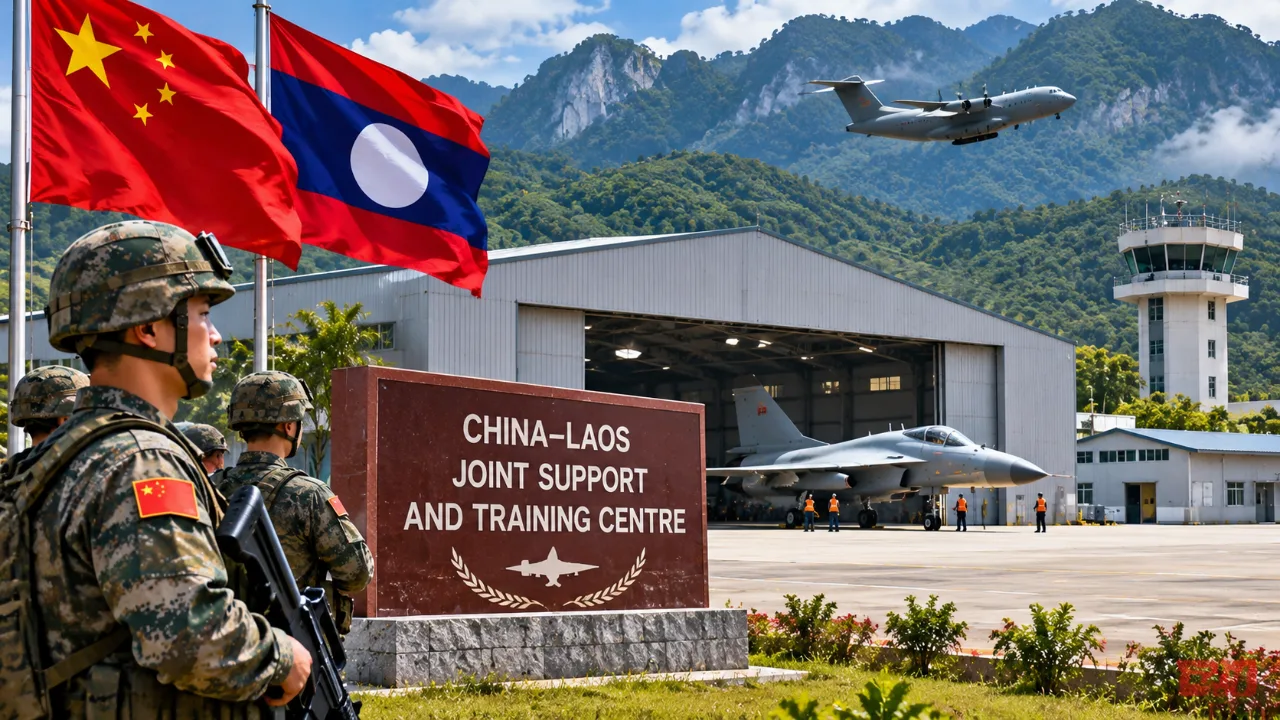
The China-Laos Joint Support and Training Centre at Ban Keun Airport, north of Vientiane, formally began operations in September 2026 alongside the China-Laos Friendship Aviation Academy. Beijing describes the facility as a joint initiative intended primarily to train Lao air force pilots and strengthen bilateral military cooperation. Its stated purpose is not to target any third country.
Yet the significance of the facility extends beyond its official training role. Its infrastructure, location and association with China's expanding military relationship with Laos provide Beijing with an additional foothold in a region where its strategic influence has grown considerably.
For China, the immediate gain is access. Unlike military facilities located within its own territory, a presence in Laos gives the People's Liberation Army an opportunity to operate, train and maintain a more sustained institutional relationship with a neighbouring country's armed forces. It also provides a potential logistical location for personnel, equipment and military cooperation activities.
The facility's value may increase over time. Analysts have pointed to the possibility of additional personnel, aircraft deployments, equipment storage and expanded support functions. Satellite imagery reported in October showed aircraft and military vehicles at the site, although their presence does not by itself establish a permanent Chinese combat deployment. The distinction between a joint training centre and a fully operational overseas military base remains important.
Nevertheless, Beijing has secured something strategically useful: an institutional presence that could be expanded without immediately requiring the establishment of a conventional foreign military base. Such arrangements allow China to deepen military relationships, gain operational experience overseas and develop access that may become more significant in a future crisis.
Ban Keun also needs to be understood alongside China's wider regional presence. Beijing established its first overseas military base in Djibouti in 2017 and has expanded its involvement in Cambodia's Ream Naval Base. The facility in Laos adds an air component to this emerging network of overseas military access arrangements.
The geographical connection is particularly relevant. Laos shares a border with China and occupies a central position in mainland Southeast Asia. Its transport links, including the China-Laos railway, connect the country more closely with China's southwestern provinces. Economic infrastructure and military cooperation are therefore developing within an increasingly integrated bilateral relationship.
For Beijing, this offers strategic depth. A stronger presence in Laos could support military exercises, training exchanges, logistics and intelligence-related activities. It may also provide an additional location from which China can monitor developments in mainland Southeast Asia and strengthen its defence diplomacy.
Vietnam has particular reasons to monitor these developments. Hanoi has traditionally maintained close political, military and economic relations with Laos, regarding the country as important to its security environment. China’s growing influence in both Laos and Cambodia creates a new strategic challenge for Vietnam, particularly given the continuing rivalry between Beijing and Hanoi in the South China Sea.
The possibility of a more permanent Chinese military presence in Laos could complicate Vietnam's defence planning. A Chinese facility west of Vietnam, combined with Beijing's expanding maritime presence, would add another dimension to Hanoi's strategic calculations. However, the extent of any military advantage should not be overstated. Ban Keun is not a naval installation, and its landlocked location imposes clear limitations on China's ability to project power across the wider Indo-Pacific.
This geographical constraint raises the central question of whether the investment will deliver military returns proportionate to its strategic ambitions.
China already operates large and well-equipped air bases in its southern provinces. Aircraft can be deployed from these facilities without the additional logistical and political complications associated with operating from another country. Laos also has no direct access to the sea, limiting the facility's usefulness for naval operations and reducing its value as a platform for sustained maritime power projection.
Any expansion would require additional investment in personnel, maintenance, fuel infrastructure, aircraft support, communications and security. It would also depend on the continuing consent and cooperation of the Lao government. A facility may offer Beijing access today, but access is not equivalent to unrestricted control.
The economic relationship between the two countries adds another dimension. Laos has become heavily dependent on Chinese investment and financing. China is its largest bilateral creditor, while the International Monetary Fund has estimated Lao public debt at around 81 per cent of GDP. Chinese involvement in the country's electricity transmission sector and major infrastructure projects has further strengthened Beijing's economic position.
This dependence gives China considerable influence, but it also creates risks. A military relationship built on economic asymmetry may generate political sensitivities within Laos and among neighbouring countries. If the facility is perceived as a permanent Chinese military base rather than a genuinely joint training arrangement, Vientiane could face pressure to reassure its neighbours and preserve its foreign policy independence.
Laos has historically pursued a policy of non-alignment, maintaining relationships with China, Vietnam, Thailand and other regional partners. Its close ties with Beijing do not necessarily mean it intends to abandon that balancing approach. The Lao leadership has its own interests in military modernisation, training and economic development. Cooperation with China can serve those objectives without automatically implying an exclusive military commitment.
This distinction is important for assessing the long-term durability of China's foothold. Beijing may have secured a valuable partnership, but it cannot assume that Vientiane will indefinitely accept every expansion of Chinese military activity. Laos must also consider its relations with Vietnam, Thailand and other ASEAN members, all of whom have an interest in preventing mainland Southeast Asia from becoming an arena of intensified military competition.
There is also a financial question for Beijing. Overseas military facilities require continuing expenditure, even when their operational use remains limited. Personnel rotations, infrastructure maintenance, equipment support and logistical arrangements create recurring costs. If Ban Keun remains primarily a training centre, its strategic return may be modest relative to the investment and political attention required to maintain it.
If China attempts to expand its role, the costs could rise further. A longer runway, more advanced aircraft, additional support infrastructure and permanent personnel would increase the facility's operational potential, but would also make its military character more visible. That could intensify regional concerns and encourage neighbouring countries to strengthen their own security partnerships.
The United States and its regional partners already maintain a much wider network of military access arrangements and alliances across the Indo-Pacific. China's expansion in Laos may help narrow one aspect of its overseas access deficit, but it does not fundamentally alter the regional military balance. A single inland facility cannot replicate the logistical reach, maritime access and established alliance structures available to the United States.
For India, developments in Laos also deserve attention. China's growing military and economic presence in mainland Southeast Asia is relevant to the wider Indo-Pacific balance, including the security environment around the Bay of Bengal and the eastern approaches to the Indian Ocean. Beijing's expanding relationships with regional partners could increase its strategic options, even if Ban Keun itself offers limited immediate power-projection capabilities.
India's interests are closely connected to the stability of Southeast Asia, the strength of ASEAN's strategic autonomy and its expanding engagement with countries along the Mekong. Developments that increase regional dependence on a single external power deserve careful assessment. At the same time, New Delhi should distinguish between China's growing influence and an established military capability to operate across the region. The former is evident; the latter remains constrained by geography, logistics and political considerations.
Ultimately, China's facility in Laos should be assessed as a long-term strategic investment rather than an immediate military breakthrough. Its importance lies in the access, relationships and future options it may provide. The facility does not yet demonstrate that Beijing has acquired an unrestricted overseas air base or a major new platform for regional combat operations.
For China, the potential reward is greater strategic depth and a stronger military relationship with a neighbouring country. The potential cost is a continuing financial commitment, increased regional suspicion and the risk that Laos may resist any attempt to turn cooperation into permanent military dependence.
The outcome will depend on what happens next at Ban Keun. The scale of Chinese personnel deployments, the types of aircraft stationed there, any runway expansion, the development of support infrastructure and the terms governing access will reveal whether the facility remains a joint training centre or evolves into something more substantial.
China has gained an additional foothold in mainland Southeast Asia. Whether that foothold becomes a durable strategic asset or an expensive symbol of influence will depend not on the announcement of the facility, but on its actual military utility, the political choices of Laos and Beijing's ability to sustain its overseas ambitions without provoking the very regional resistance that could limit them.