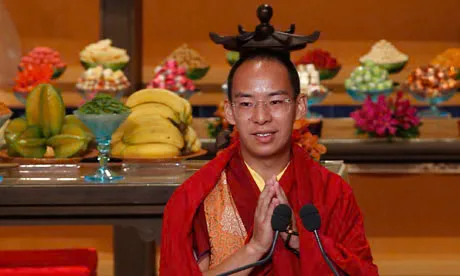
The endorsement of China’s Ethnic Unity and Progress Promotion Law by Beijing-appointed Panchen Lama Gyaltsen Norbu has brought renewed attention to the growing intersection of political authority and religious institutions in Tibet. As the dispute over the Dalai Lama’s succession approaches a critical stage, his public support for the legislation raises wider questions about the independence of Tibetan Buddhist traditions under Chinese rule.
On August 14, 2026, Gyaltsen Norbu reportedly described compliance with the ethnic unity law as an expression of true Dharma, linking Buddhist religious obligations with the political framework promoted by Beijing. His position, reported by Tibetan Review on August 20, has added another dimension to concerns over the Chinese government’s efforts to align religious practice with its national integration policies.
The issue is not simply whether religious leaders should comply with the laws of the country in which they operate. It is whether the state can define the interpretation of religious teachings and make political conformity part of religious responsibility. When a government’s political objectives are presented as expressions of spiritual duty, the boundary between religious guidance and state-directed ideology becomes increasingly difficult to maintain.
For Tibetan Buddhists, this question carries particular weight because of the circumstances surrounding Gyaltsen Norbu’s position. In 1995, the 14th Dalai Lama recognised Gedhun Choekyi Nyima as the reincarnation of the 10th Panchen Lama. Chinese authorities rejected that recognition and subsequently installed Gyaltsen Norbu through a state-supervised process. Gedhun Choekyi Nyima has remained out of public view since then. Beijing maintains that he is living a normal life, but independent access has not been provided to resolve continuing concerns about his whereabouts and welfare.
The competing claims to the Panchen Lama institution have become a defining issue in the wider debate over religious authority in Tibet. Gyaltsen Norbu has since occupied prominent positions within China's officially recognised Buddhist establishment, with his public statements frequently reflecting the government's emphasis on patriotism, national unity and the adaptation of religion to the country's socialist political system.
His position on reincarnation has also brought the dispute into direct focus. In December 2025, he said reincarnated Buddhist leaders must be identified within China and approved by the central government. He also argued that the process must comply with Chinese law and uphold Communist Party leadership.
That position directly conflicts with the Dalai Lama’s July 2025 declaration that the Gaden Phodrang Trust would have authority over identifying his successor. The disagreement raises the possibility of competing claims to the next Dalai Lama, with Beijing potentially recognising one candidate while followers of the present Dalai Lama accept another.
The consequences would extend well beyond a disagreement over religious procedure. The authority to identify reincarnated leaders is central to the continuity of Tibetan Buddhist institutions. Government approval may confer official recognition within China, but it cannot automatically establish acceptance among Tibetan Buddhists.
The Ethnic Unity and Progress Promotion Law adds another layer to these concerns. Beijing presents the legislation as a means of strengthening national cohesion, protecting lawful rights and promoting cooperation among ethnic groups. Critics, including Tibetan rights organisations, argue that its emphasis on a common Chinese national identity could weaken the distinctive linguistic, cultural and religious traditions of minority communities.
The implications are not confined to religious appointments. Tibetan-language education, the transmission of Buddhist teachings, monastic institutions and cultural practices all depend on the space available for communities to preserve their heritage. If these activities are increasingly assessed through the lens of political conformity, the scope for independent religious and cultural expression could narrow.
The concerns were reinforced on September 30, 2026, when Gyaltsen Norbu chaired a meeting of the Tibet branch of the Buddhist Association of China in Shigatse. According to a Xinhua report cited by Tibetan Review, he called for greater study and promotion of the ethnic unity law and religious regulations, while emphasising that religious work should remain aligned with the Communist Party’s priorities.
These developments illustrate the tension between Beijing’s model of state-supervised religion and the traditional understanding of Tibetan Buddhist authority. They do not independently establish the extent to which the Chinese government directs Gyaltsen Norbu’s individual decisions. However, his public positions demonstrate a clear alignment with the political framework governing officially recognised religious institutions.
The timing is especially significant. With the question of the Dalai Lama’s succession already emerging as a major point of contention between Beijing and the Tibetan exile community, the role of the Panchen Lama could become central to the next phase of the dispute. The Panchen Lama traditionally holds an important position in the recognition of reincarnated Tibetan Buddhist leaders, making competing claims to the institution particularly consequential.
The larger issue is whether Tibetan Buddhism will retain the authority to determine its own religious leadership and preserve its traditions independently of political directives. China can establish rules for religious institutions operating under its jurisdiction and decide which figures receive official recognition. But legal recognition and religious legitimacy are not necessarily the same.
For Tibetan Buddhists, the future of their faith cannot be measured solely by the positions occupied by state-approved religious figures. It also depends on whether monasteries, teachers and communities can transmit their beliefs without being required to subordinate spiritual obligations to political ideology.
The endorsement of the ethnic unity law by Beijing-appointed Panchen Lama Gyaltsen Norbu therefore carries significance beyond the legislation itself. It highlights the growing debate over who has the authority to define religious practice in Tibet. As the Dalai Lama’s succession draws closer, that question will become increasingly difficult to separate from the future of Tibetan identity, religious freedom and the independence of its spiritual institutions.