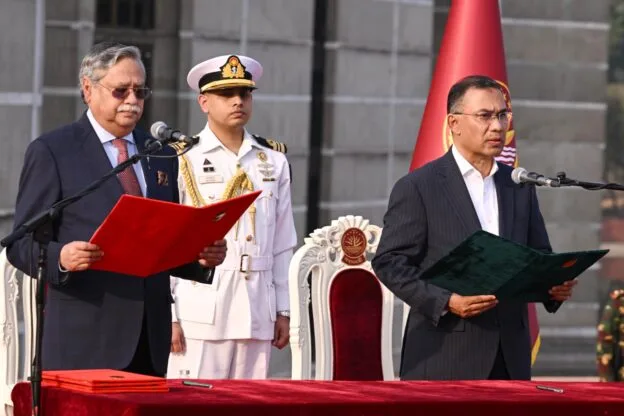
Bangladesh’s political transition was supposed to offer more than a change of government. After the upheaval that followed Sheikh Hasina’s departure in August 2024, the return to elected rule raised expectations that the country could rebuild its institutions, restore public confidence and break with the political practices that had undermined accountability.
Eight months after the Bangladesh Nationalist Party (BNP) took office under Prime Minister Tarique Rahman, that promise remains only partly fulfilled.
The government has some achievements to point to. Remittances have increased, inflation has eased from its recent peak, and elected institutions are functioning again. Yet households continue to face rising costs, businesses remain reluctant to invest, and concerns over public safety and mob violence persist. Meanwhile, constitutional reforms endorsed in a referendum remain contested, while new legislation governing human rights and enforced disappearances has raised questions about the independence of oversight institutions.
The emerging picture is not one of complete failure. It is something more consequential: a government that has begun to restore political normality but has yet to demonstrate that it intends to transform the institutions through which power is exercised.
The return of elections was only the beginning
Bangladesh’s February 2026 election restored an elected government after an extended period of political upheaval and interim administration. For many voters, the BNP’s victory represented an opportunity to move beyond the confrontations that had defined the country’s politics for years.
But elections are a starting point for democratic renewal, not its final measure.
A government can win a legitimate mandate and still fall short of the expectations that brought it to power. The harder test is whether it accepts meaningful constraints on its own authority, protects political competition and strengthens institutions capable of scrutinising its decisions.
The BNP inherited serious problems. The economy remained under pressure, the security environment was fragile, and the institutional legacy of the previous administration required substantial repair. Those conditions make rapid transformation difficult.
They do not, however, explain every decision the government has made since taking office.
The central question is whether the BNP sees reform as a commitment that must be honoured even when it limits the government's freedom of action—or as a political promise that can be selectively implemented when circumstances permit.
Economic relief has yet to reach ordinary households
The economy offers a mixed assessment of the government’s first eight months.
Inflation eased to 8.34 per cent in September, down from 9.42 per cent in May. Yet the improvement has been modest when measured against household experience: consumer prices were still rising, and inflation remained close to the level recorded a year earlier.
For workers, slower inflation does not necessarily mean an improvement in living standards. The wage index for selected lower-paid occupations rose by 8.05 per cent in August, trailing the rate of price increases. That gap suggests continued pressure on the purchasing power of workers in agriculture, construction and transport.
Remittances provide a more encouraging indicator. Bangladesh received $18.94 billion between March and August, an increase of 13.1 per cent from the same period in 2025. These inflows have supported households and helped strengthen foreign-exchange reserves, although the upward trend began before the BNP took office.
The broader investment picture remains less reassuring. Businesses have reported weak demand, expensive borrowing and energy shortages. Higher fuel costs have added to the pressure, while limited revenue collection has constrained the government’s capacity to finance its spending commitments.
These problems are not all of the BNP’s making. The government inherited monetary and financial pressures that cannot be resolved in a few months. The conflict in the Middle East has also disrupted energy markets, complicating Bangladesh’s economic recovery.
But a government judged by the promise of economic renewal must eventually move beyond explaining inherited difficulties. It must show that its policies are improving productivity, encouraging investment, strengthening revenue collection and creating better employment opportunities.
The risk is that short-term spending commitments and large infrastructure or procurement projects will absorb scarce resources without addressing the structural weaknesses holding back growth. Economic recovery requires more than stabilising prices. It requires a credible plan for making growth sustainable and its benefits more widely felt.
Security cannot be separated from accountability
Public safety remains another test of the BNP’s governing record.
Police figures indicate that registered murder, robbery and kidnapping cases declined between March and September compared with the same period in 2025. Burglary cases, however, increased, while mob killings and extortion continued to raise concern.
These figures do not support a simple conclusion that the security situation has either dramatically improved or collapsed. They point instead to uneven progress and unresolved weaknesses in law enforcement.
The deeper problem is institutional. Effective policing depends on consistent enforcement, professional investigations and the willingness to pursue powerful individuals as well as ordinary offenders.
If political connections continue to shield influential figures from investigation, changes in government will not fundamentally alter the relationship between power and accountability.
The BNP therefore faces a test that extends beyond crime statistics: whether it can prevent its own supporters and political networks from exercising influence over law enforcement. A government that promises a break with the past must be willing to investigate wrongdoing within its own ranks.
The same principle applies to attacks on journalists, political intimidation and mob violence. Public order cannot be established sustainably if citizens believe that political affiliation determines whose rights receive protection.
Reform is where the BNP faces its hardest questions
The most consequential test of the government may be its response to the constitutional reform agenda developed after the 2024 uprising.
Voters endorsed a reform package in a referendum held alongside the February election. The proposals included limits on the prime minister’s tenure, the creation of a second parliamentary chamber and stronger safeguards for judicial independence.
Yet the implementation process has become a source of political conflict.
The BNP has argued that constitutional changes must follow established parliamentary procedures and has resisted the proposed mechanism under which elected lawmakers would serve as a separate constitutional reform council. Opposition parties, including Jamaat-e-Islami and the National Citizen Party, have argued that the referendum created a mandate for the agreed process.
The disagreement is not merely procedural. It concerns who gets to determine the terms of reform and whether the electoral victory of one party allows it to reshape a broader national mandate.
The government has established a parliamentary committee to discuss constitutional changes, but the opposition’s refusal to participate has weakened the prospect of a broad agreement. Key questions remain unresolved.
There is a legitimate argument that constitutional reform must be legally sound and politically workable. But procedural objections can also become a means of delaying changes that would limit the authority of those currently in power.
The BNP must therefore demonstrate that its alternative process can deliver the substance of the promised reforms, rather than simply replacing one mechanism with another and leaving the underlying commitments unfulfilled.
The distinction is crucial. A constitutional committee is not itself a democratic reform. Its value depends on what it produces.
Independent institutions cannot be built through political convenience
The government’s approach to human rights and accountability legislation has generated further concerns.
New laws on the National Human Rights Commission and enforced disappearances have been criticised by rights advocates who argue that the arrangements weaken independent oversight, particularly when allegations involve security forces.
The key issue is whether institutions investigating abuses can operate independently of the agencies they may need to scrutinise. If investigations into alleged wrongdoing by security personnel depend heavily on bodies selected or controlled by the government, the promise of accountability becomes difficult to sustain.
The BNP can argue that legal frameworks must be practical and consistent with the country’s institutions. But institutional design must also address the imbalance of power between alleged victims and the state agencies accused of misconduct.
Reforming an institution means more than restoring its leadership or allowing it to resume work. It means ensuring that it has the authority, independence and protection necessary to act when its findings are politically inconvenient.
This is where the government’s record will have long-term consequences. Bangladesh’s democratic recovery depends not simply on the presence of elected leaders but on whether courts, watchdogs, law-enforcement agencies and the media can scrutinise those leaders without fear of retaliation.
The same test applies to political pluralism. The continued ban on Awami League activities leaves a substantial part of the country’s political landscape outside normal party competition. The ban has been defended in the context of accountability for abuses committed under the former government, but restrictions on political organisation also raise questions about the boundaries between prosecuting alleged wrongdoing and excluding an entire political movement.
Accountability should be based on evidence and individual responsibility. A durable democratic system cannot rely indefinitely on blanket political exclusion as a substitute for due process.
Foreign policy has become a balancing act
Tarique Rahman’s foreign policy reflects the practical pressures facing Bangladesh as it seeks investment, energy security and stable relations with major powers.
Relations with India remain difficult. Sheikh Hasina’s presence in India and Dhaka’s demand for her extradition continue to complicate engagement. Disputes over visas, trade restrictions and water sharing add to the friction, while the expiry of the Ganges water treaty later this year increases the urgency of negotiations.
China, by contrast, has offered opportunities for cooperation on infrastructure and river management. Beijing’s support for projects involving Mongla Port, the Chinese Economic and Industrial Zone in Chittagong and the Teesta river management initiative provides Dhaka with additional options.
But closer ties with China do not eliminate the need for constructive relations with India. The Teesta project, for example, may benefit from Chinese assistance, yet it does not resolve the separate question of water sharing between Bangladesh and India.
The United States is another important partner. Trade arrangements, tariff pressures and aircraft purchases have become part of Dhaka’s effort to preserve market access and strengthen economic ties. Bangladesh must also manage its relations with Gulf countries, which are important sources of employment and remittances.
The challenge is to pursue these relationships without allowing short-term diplomatic gains to substitute for a coherent national strategy. Bangladesh needs reliable access to energy, investment and export markets. That requires predictable institutions at home as much as skilful diplomacy abroad.
The danger of replacing one political system with another
Bangladesh’s recent history offers a warning against treating political turnover as proof of institutional change.
The departure of one dominant political leadership does not automatically dismantle the networks, incentives and practices that allowed power to become concentrated. A new government can inherit those structures and gradually adapt them to its own interests.
That is the central risk facing the BNP.
If it delays constitutional reforms, weakens independent oversight or allows political connections to influence law enforcement, it may reproduce some of the problems it promised to correct. The individuals in power may change, but the relationship between political authority and accountability could remain largely intact.
This is not a claim that the BNP’s first eight months determine the fate of Bangladesh’s democracy. Governments require time to implement complex reforms, and the country faces genuine economic and security constraints.
But the early direction matters. Institutions are difficult to reform once political actors become comfortable with the powers they inherit. Delays can turn temporary compromises into permanent arrangements.
The government must therefore demonstrate that its reform agenda is not dependent on whether the proposed changes benefit the party in office.
Eight months is too early for a verdict—but not for warning signs
The BNP’s first eight months have produced mixed results. Remittances have increased, inflation has eased from its peak, and the country has returned to elected government. These are meaningful developments, even if some improvements began before the party took office.
At the same time, household purchasing power remains under pressure, investment is subdued, public safety concerns persist and key institutional reforms remain contested.
The most important question is not whether the BNP has solved Bangladesh’s problems in eight months. No government could reasonably be expected to do so. It is whether the government is building the conditions under which those problems can be addressed sustainably.
That means protecting political competition, strengthening independent oversight, improving the accountability of law enforcement and implementing the reform commitments endorsed by voters. It also means pursuing economic policies that address structural weaknesses rather than relying on short-term measures.
Bangladesh’s democratic transition will ultimately be judged by whether citizens become safer, more prosperous and freer to hold their leaders accountable.
The BNP came to power with an opportunity to show that Bangladesh could move beyond the politics of concentrated authority. Eight months later, that opportunity remains open—but the government has yet to prove that it is willing to limit its own power in order to change the system.