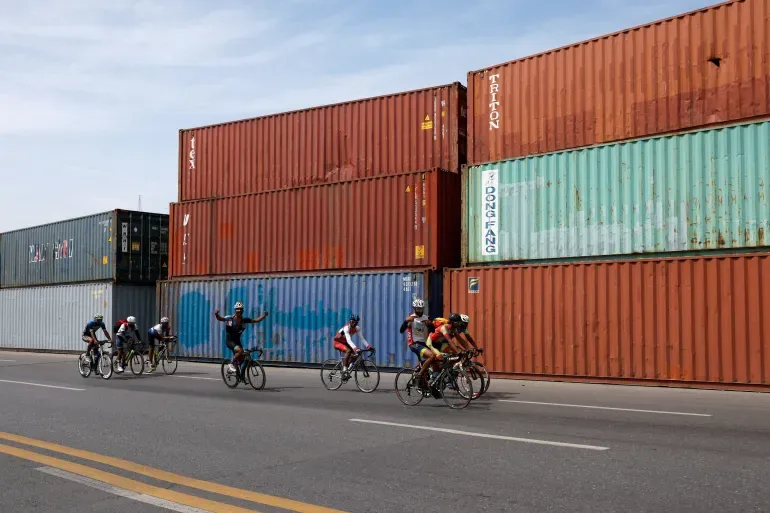
ISLAMABAD — Thousands of shipping containers deployed to block roads ahead of a planned opposition march have turned Pakistan’s capital into a prolonged security zone, disrupting transport, stranding drivers and imposing costs on businesses as authorities prepare for another confrontation with supporters of jailed former Prime Minister Imran Khan.
The containers have been in place for nearly four weeks as the government seeks to prevent a planned march by Khan’s Pakistan Tehreek-e-Insaf (PTI). The party initially planned to begin its mobilisation on September 27 but postponed the march to October 4, citing strategic reasons.
Transport associations and officials estimate that between 1,500 and 2,000 heavy containers and vehicles have been deployed across Islamabad, Punjab and Khyber Pakhtunkhwa. Some have been used as barricades, while others remain held at police facilities and roadside locations.
For truck owners and drivers, the measures have created a direct financial burden. Muhammad Owais Chaudhry of the All Pakistan Goods Transport Owners Association said a truck and container combination can generate between 30,000 and 40,000 rupees a day when operating. He said owners whose vehicles have been held have received no compensation.
The government disputes that account.
State Minister for Interior Talal Chaudhry said containers were being hired through established contractual arrangements and that legitimate payments were being processed through official channels. He rejected claims that the government had simply seized private vehicles without compensation.
The disagreement highlights a wider uncertainty over who owns the containers and who bears the cost when they are taken off the road.
Some belong to transporters, while others are owned by international shipping companies and are mounted on locally owned trucks. Industry representatives say thousands of containers are now effectively immobilised.
Mehmood ul Hassan Awan, a Karachi-based customs agent and importer, said many of the containers belong to foreign shipping lines. He estimated that penalties of between $150 and $300 a day could accumulate on individual containers held beyond their permitted return period, creating additional costs that ultimately leave Pakistan.
The government has defended the security measures as necessary preparations for protecting the federal capital.
Talal Chaudhry said authorities were acting on intelligence assessments and anticipated security requirements rather than simply responding to the date of the planned protest. He said Islamabad, as the federal capital, routinely requires extensive security arrangements before major political events.
The financial cost is already substantial. Islamabad police initially sought about 820 million rupees for a week of security arrangements surrounding the PTI march. With the protest postponed, officials now expect the final bill to exceed 1 billion rupees.
Container rental alone has been estimated at about 46.5 million rupees a day for more than 1,500 containers.
The expenditure comes on top of previous security costs. In a written response to Pakistan’s National Assembly in March 2025, Interior Minister Mohsin Naqvi said the government had spent 1.35 billion rupees on law-and-order deployments in Islamabad over five years. The figure included police transportation, accommodation and meals, as well as anti-riot equipment in one year, but did not separately identify spending on containers.
For drivers, the disruption has become an extended period of uncertainty.
Several drivers interviewed in Islamabad said they had been instructed by vehicle owners to remain near their trucks while the vehicles were held. Some have been waiting for weeks without a clear release date.
Muhammad Saleem Jaffar, a driver whose truck was stopped by police in the early hours of the morning after he had completed a delivery, said he had not been told when the vehicle would be released. Other drivers described shortages of basic facilities, including access to washing facilities and toilets.
The transporters say the problem is not limited to lost income. They are also concerned about potential damage to vehicles and the absence of written orders explaining why individual trucks have been detained.
Haji Atlas Khan, a transporter from Khyber Pakhtunkhwa, said four of his trucks were impounded during the security operation. He said neither he nor his drivers initially received a clear explanation of the legal authority under which the vehicles had been taken.
Government officials maintain that loaded vehicles are returned and that empty containers used for security purposes are handled under rental arrangements. Transporters, however, say they have received little clarity about when their vehicles will be released or how losses will be addressed.
The economic effects extend beyond the transport industry.
Islamabad's roads have been repeatedly blocked or restricted in recent weeks, affecting commuters, businesses and access between the capital and neighbouring Rawalpindi. Researchers and business representatives say prolonged restrictions can produce wider losses through cancelled hotel bookings, disrupted deliveries and reduced commercial activity.
Sajid Amin Javed of the Sustainable Development Policy Institute said the cost could extend beyond direct government spending because prolonged disruption can influence business confidence and investment decisions.
The use of shipping containers as political barricades is not new in Islamabad. Similar measures have been deployed during previous PTI demonstrations, including protests in 2024. The practice has become sufficiently familiar that some residents now refer to the capital as “Containerabad”.
For the government, the barricades are a security measure intended to prevent another large-scale political mobilisation from reaching sensitive areas of the capital. For transporters, however, the containers represent vehicles taken out of service, unpaid losses and an uncertain wait for their return.
As the October 4 protest approaches, the dispute over the containers has become another source of tension surrounding the planned march. The political confrontation has yet to begin, but its economic cost is already being borne by the state, transport companies, drivers and businesses across the capital.